Laser Design Engineer Interview Guide
This collection distills the interview-relevant theory and engineering practice from seven local references. Three provide the main conceptual and design spine:
Jeff Hecht, Understanding Lasers: An Entry-Level Guide, fourth edition (2019);
Norman Hodgson and Horst Weber, Laser Resonators and Beam Propagation, second edition (2005); and
Walter Koechner, Solid-State Laser Engineering, sixth revised edition (2006).
Four focused references deepen the engineering and measurement treatment:
Richard Scheps, Introduction to Laser Diode-Pumped Solid State Lasers (2002);
Travis S. Taylor, Introduction to Laser Science and Engineering, first edition (2020);
Sean Ross, Laser Beam Quality Metrics (2013); and
Detlev Ristau, editor, Laser-Induced Damage in Optical Materials (2015).
The text is an independent technical synthesis. It paraphrases concepts rather than reproducing the books. Use the Source Map and Further Reading to return to the relevant chapters when a topic needs deeper study.
For the supplied job description, begin with Role-Specific Interview Playbook, then study DUV Laser Integration and Qualification. These pages map the general laser material to the role’s requirements allocation, feasibility benches, integration, qualification, automation, motion control, cross-functional execution, and product-introduction responsibilities.
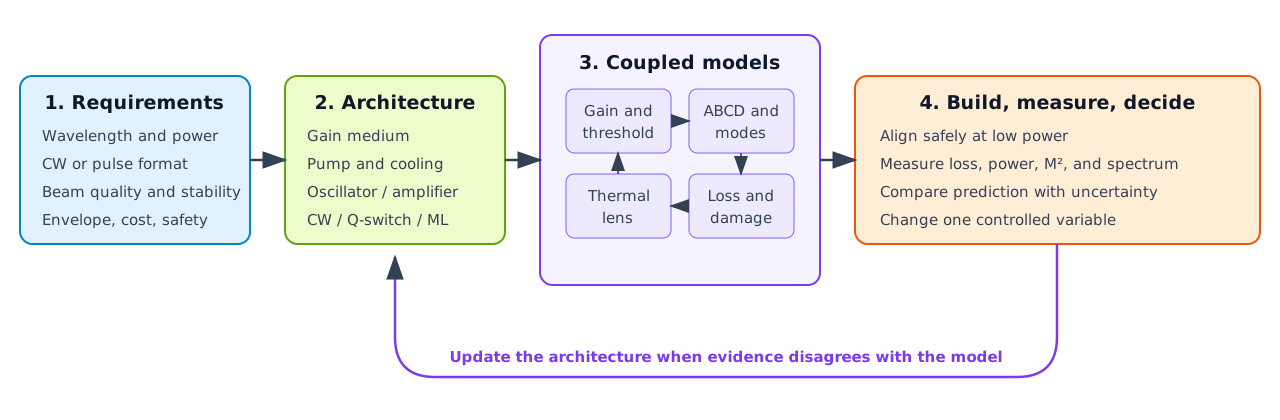
Figure 1. A strong design answer closes the loop between requirements, coupled models, and measured evidence.
What an interviewer is testing
Dimension |
Strong evidence |
Weak answer pattern |
Best page here |
|---|---|---|---|
Physics |
Derives threshold, mode size, or pulse relations and states assumptions |
Recites a laser definition without closing the energy or loss balance |
|
Optical design |
Uses ABCD matrices, checks stability over thermal-lens range, and reserves apertures |
Designs only at one nominal focal power |
|
System engineering |
Connects gain medium, pump, cooling, coatings, extraction, safety, and controls |
Optimizes one component in isolation |
|
Laboratory judgment |
Aligns at low power, measures with calibrated tools, and changes one variable at a time |
Chases maximum power without a baseline or damage controls |
|
Qualification |
Defines beam quality and damage limits using application-specific, traceable conditions |
Quotes an instrument’s \(M^2\) or a catalog LIDT without the measurement basis |
Beam Quality: Specify, Measure, and Interpret and Laser-Induced Damage Engineering |
Communication |
Starts from requirements, names assumptions, estimates, verifies, then discusses risk |
Gives a number without units, tolerance, or validation plan |
Worked Interview Design Case and Interview Questions and Answer Frameworks |
Productization |
Converts prototype knowledge into controlled tests, procedures, training, and yield feedback |
Treats first light or one passing unit as completion |
Role-Specific Interview Playbook and DUV Laser Integration and Qualification |
Recommended preparation order
Map your own projects to the evidence matrix in Role-Specific Interview Playbook and prepare the six requested stories with numerical results.
Learn the architecture fork, materials, purge, alignment, and lifetime risks in DUV Laser Integration and Qualification.
Memorize the governing equations and verbal explanations in Laser Theory Essentials.
Work the cavity and Gaussian-beam calculations in Resonators and Gaussian Beams without notes.
Practice turning requirements into a solid-state architecture with Solid-State Laser Design, Diode-Pumped Solid-State Laser Engineering, and Worked Interview Design Case.
Learn to defend the source specification and qualification evidence with Beam Quality: Specify, Measure, and Interpret and Laser-Induced Damage Engineering.
Rehearse the alignment, measurement, and fault-isolation sequences in Hands-On Alignment, Measurement, and Debugging.
Answer Interview Questions and Answer Frameworks aloud. Keep the first answer under 90 seconds, then expand only when asked.
- Role-Specific Interview Playbook
- DUV Laser Integration and Qualification
- Laser Theory Essentials
- Resonators and Gaussian Beams
- Solid-State Laser Design
- Diode-Pumped Solid-State Laser Engineering
- Beam Quality: Specify, Measure, and Interpret
- Laser-Induced Damage Engineering
- Hands-On Alignment, Measurement, and Debugging
- Worked Interview Design Case
- Interview Questions and Answer Frameworks
- Source Map and Further Reading