7.8 Example — Doublet Lens Zernike
PDF section 7.8. Source script: KrakenOS/Examples/Examp_Doublet_Lens_Zernike.py.
Loads a 36-element ZNK array (Noll-ordered Zernike coefficients) onto
the rear surface of the doublet to deform it. Tracing the same fan of rays
visualises the surface departure and the resulting wavefront effect.
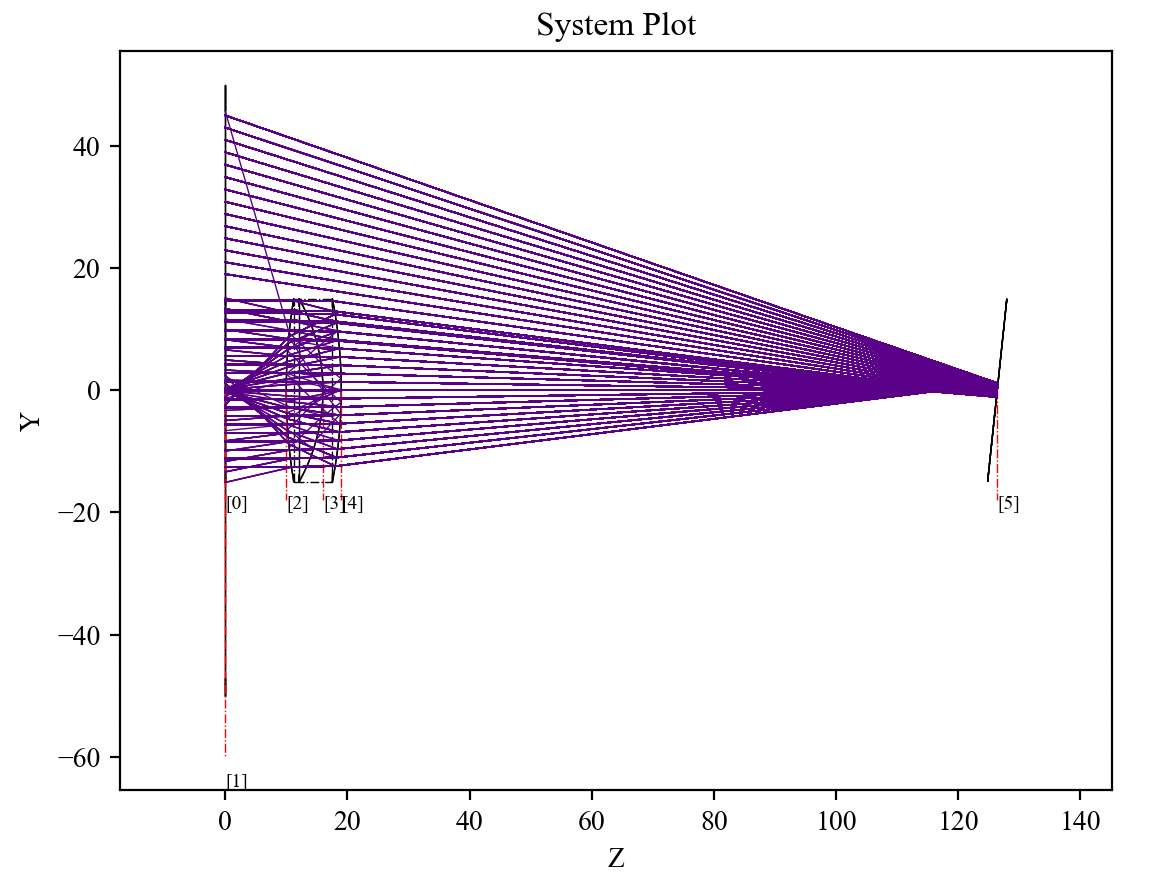
Figure 15a. Doublet with a surface defined by Zernike-polynomial coefficients.
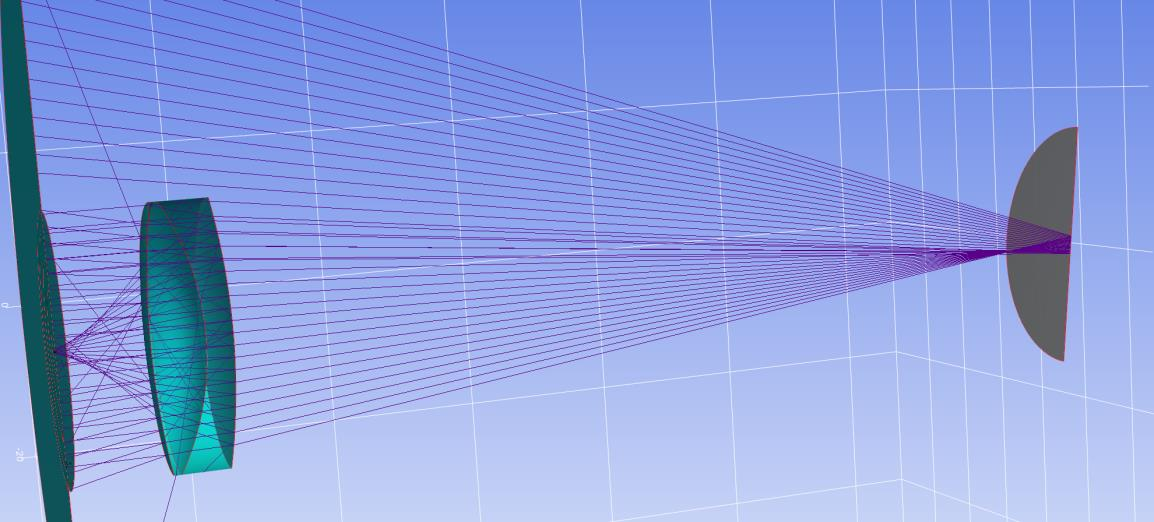
Figure 15b. Same system in 2D.
#!/usr/bin/env python3
# -*- coding: utf-8 -*-
"""Doublet Lens Zernike"""

from importlib import metadata
required = {'KrakenOS'}
installed = {dist.metadata["Name"] for dist in metadata.distributions() if dist.metadata.get("Name")}
missing = {pkg for pkg in required if pkg not in installed}

if missing:
    print("No instalado")
    import sys
    sys.path.append("../..")


import KrakenOS as Kos


import numpy as np
import matplotlib.pyplot as plt
import time

# ______________________________________#

P_Obj = Kos.surf()
P_Obj.Rc = 0.0
P_Obj.Thickness = 1
P_Obj.Glass = "AIR"
P_Obj.Diameter = 30.0

# ______________________________________#

L1a = Kos.surf()
L1a.Rc = 5.513435044607768E+001
L1a.Thickness = 6.0
L1a.Glass = "BK7"
L1a.Diameter = 30.0

# ______________________________________#

L1b = Kos.surf()
L1b.Rc = -4.408716526030626E+001
L1b.Thickness = 3.0
L1b.Glass = "F2"
L1b.Diameter = 30

# ______________________________________#

L1c = Kos.surf()
L1c.Rc = -2.246906271406796E+002
L1c.Thickness = 9.737871661422000E+001
L1c.Glass = "AIR"
L1c.Diameter = 30

# ______________________________________#

Z = np.zeros(36)
Z[8] = 0.5
Z[9] = 0.5
Z[10] = 0.5
Z[11] = 0.5
Z[12] = 0.5
Z[13] = 0.5
Z[14] = 0.5
Z[15] = 0.5
L1c.ZNK = Z

# ______________________________________#

P_Ima = Kos.surf()
P_Ima.Rc = 0.0
P_Ima.Thickness = 0.0
P_Ima.Glass = "AIR"
P_Ima.Diameter = 100.0

# ______________________________________#

A = [P_Obj, L1a, L1b, L1c, P_Ima]
configuracion_1 = Kos.Setup()


# ______________________________________#

Doblete = Kos.system(A, configuracion_1)
Rayos = Kos.raykeeper(Doblete)

# ______________________________________#

tam = 5
rad = 12.0
tsis = len(A) - 1
for i in range(-tam, tam + 1):
    for j in range(-tam, tam + 1):
        x_0 = (i / tam) * rad
        y_0 = (j / tam) * rad
        r = np.sqrt((x_0 * x_0) + (y_0 * y_0))
        if r < rad:
            tet = 0.0
            pSource_0 = [x_0, y_0, 0.0]
            dCos = [0.0, np.sin(np.deg2rad(tet)), np.cos(np.deg2rad(tet))]
            W = 0.4
            Doblete.Trace(pSource_0, dCos, W)

            Rayos.push()

# ______________________________________#

Kos.display3d(Doblete, Rayos, 2)
Kos.display2d(Doblete, Rayos, 1)