Introduction To Fundamental Lens Design
This chapter is a short, vendor-neutral primer on how real-world objective lenses are built up from a small number of recurring design “families”. It is intended for KrakenOS users who want to recognize the shape of a prescription in the editable table and understand why the designer chose it.
Two domains are compared:
photographic lenses – the consumer / cinema / broadcast world, where speed (large aperture), compactness, and pleasing rendering matter;
machine vision lenses – the industrial / metrology world, where low distortion, high MTF across the whole sensor, mechanical stability, and (often) telecentricity matter more than aperture or weight.
The same glass elements show up in both domains, but the priorities are different, so the typical layouts diverge.
Why “Lens Families” Exist
A practical objective has to correct, at minimum, the third-order Seidel aberrations: spherical, coma, astigmatism, field curvature, and distortion, plus axial and lateral chromatic aberration. A single lens cannot do this; the designer needs several elements with carefully chosen powers, separations, and glasses.
Over the last 130 years a handful of element arrangements turned out to balance these aberrations well. Modern designs are almost always derivatives of one of these classical “families”, with extra elements, aspherics, and exotic glasses bolted on to push performance further.
Knowing the family tells you, at a glance:
roughly how many surfaces and groups to expect in the table;
which aberrations are inherently controlled vs. which are still loose;
whether the design will be symmetric (good for distortion) or asymmetric (telephoto, retrofocus);
what its likely application niche is.
Photographic Lens Families
The Double Gauss
The Double Gauss is the most iconic fast standard-lens design. Originating with Alvan Clark (1888) and refined by Paul Rudolph at Zeiss as the Planar (1896), it dominated 35 mm SLR 50 mm f/1.4 – f/2 lenses for most of the 20th century and is still the backbone of many modern primes.
The hallmark is near-symmetry around a central stop, with a cemented doublet on each side of the aperture. The symmetry naturally cancels the odd aberrations (coma, distortion, lateral chromatic).
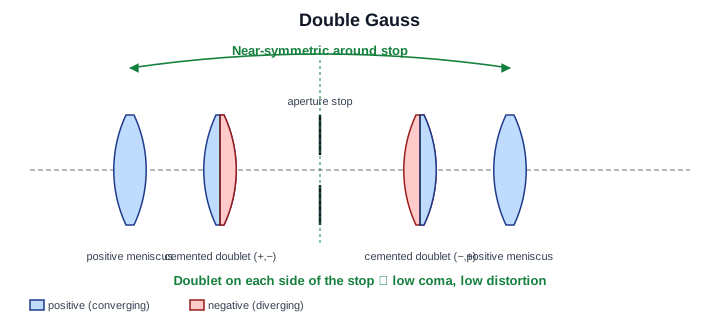
Double Gauss. Distinguishing trait highlighted in green: the design is near-symmetric around the aperture stop, with a cemented doublet on each side. Symmetry is what suppresses coma, distortion, and lateral chromatic aberration “for free”.
Typical headline properties:
6 elements in 4 groups (classic Planar / Biotar);
fast – f/2 to f/1.4 is comfortable, f/1.0 is reachable with extra elements;
moderate field of view (40°–50°), so it is the natural “normal” lens;
low distortion thanks to symmetry;
limited back-focal distance, which is fine for rangefinders and mirrorless but historically required tweaks for SLRs.
Tessar
The Tessar (Zeiss, 1902) is a 4-element / 3-group design: a positive front singlet, a negative middle, and a cemented positive doublet behind the stop. It is compact, sharp on-axis at moderate apertures (typically f/2.8 – f/4), and very cheap to manufacture, which is why countless “kit” and “pancake” lenses are Tessar derivatives.
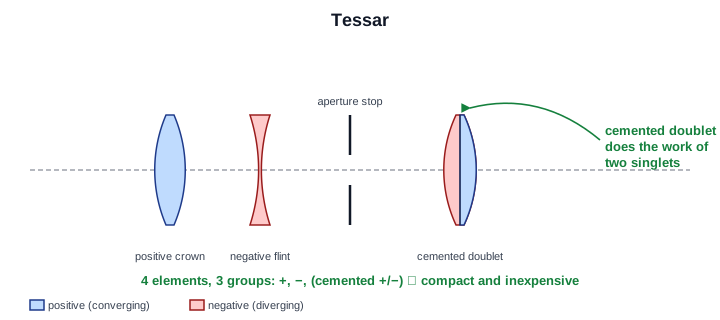
Tessar. Distinguishing trait: the rear cemented doublet (highlighted) replaces what would otherwise be two separate elements, allowing the whole lens to be done with only 4 elements in 3 groups – cheap to grind, cheap to assemble, sharp on-axis at moderate apertures.
Sonnar
The Sonnar (Bertele, Zeiss, 1929) uses thicker cemented groups and fewer air-glass surfaces than the Double Gauss. Before lens coatings existed, this gave dramatically higher contrast, and it still produces a very specific “Sonnar look” used in fast portrait and short-tele lenses (the Zeiss 85 mm f/2 and many 50 mm rangefinder lenses).
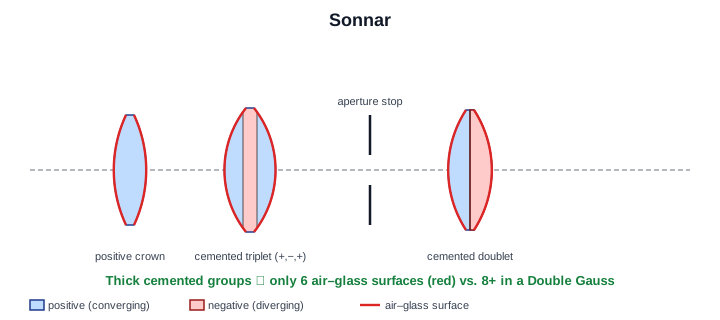
Sonnar. Distinguishing trait: thick cemented groups (a triplet plus a doublet here) – the surfaces marked in red are the only air-glass interfaces. A Double Gauss of similar element count would have roughly twice as many. In the pre-coating era this directly translated to higher contrast and less veiling flare.
Cooke Triplet
The Cooke Triplet (H. Dennis Taylor, 1893) is the simplest air-spaced arrangement that can correct all seven primary aberrations: a positive – negative – positive sequence with the stop between the negative and rear positive elements. It appears in low-cost cameras, projector lenses, and as the conceptual ancestor of the Tessar.
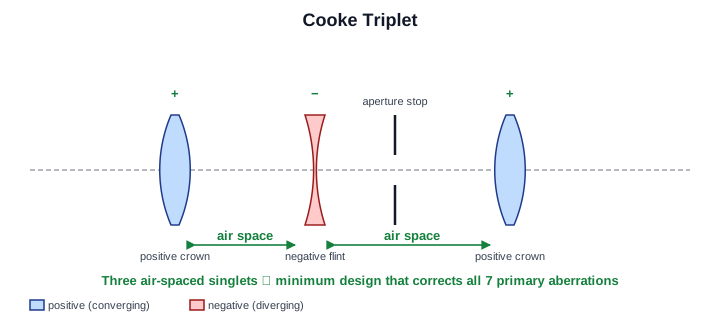
Cooke Triplet. Distinguishing trait: three air-spaced singlets in a
+, −, + sequence with the stop tucked behind the negative element.
This is the minimum element count that can correct all seven primary
aberrations simultaneously – every later air-spaced design is, in some
sense, a Cooke Triplet with more parts.
Retrofocus (Inverted Telephoto)
A retrofocus lens places a strong negative group in front of a positive rear group, deliberately making the back-focal distance longer than the focal length. This is what allows a 24 mm wide-angle lens to clear the swinging mirror of a 35 mm SLR. Most SLR wide-angles, and many short-focal-length machine-vision lenses on large sensors, are retrofocus.
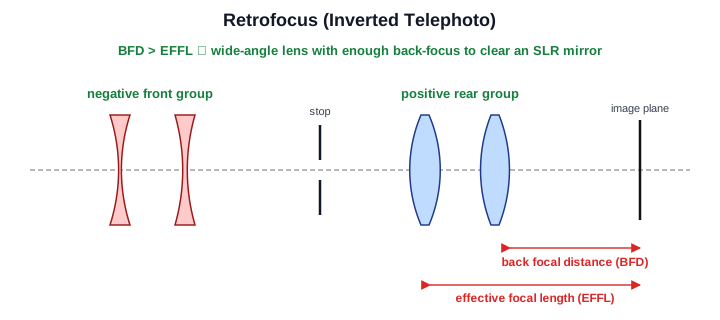
Retrofocus. Distinguishing trait: a negative group is placed in front of the positive group. The back focal distance (red) is then deliberately longer than the effective focal length (red, lower bracket) – which is exactly what allows a wide-angle lens to clear the swinging mirror of an SLR.
Telephoto
A true telephoto reverses the retrofocus idea: a positive front group and a negative rear group, so the physical length is shorter than the focal length. Most lenses called “telephotos” in casual speech are simply long-focal-length lenses, but the optical telephoto layout is what keeps a 600 mm sports lens from being 600 mm long.
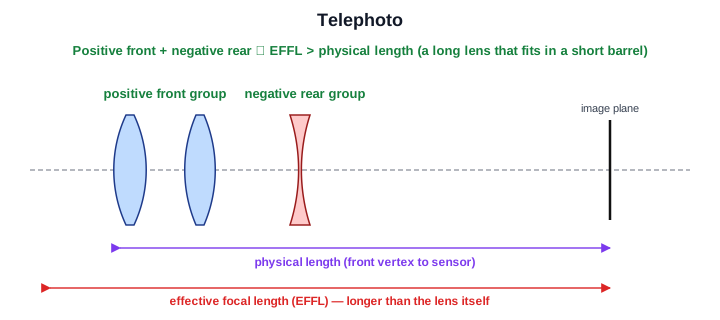
Telephoto. Distinguishing trait (compare against retrofocus): a positive group is placed in front of a negative group. The physical length of the barrel (purple bracket) is then shorter than the effective focal length (red bracket). This is what keeps a 600 mm sports lens from needing a 600 mm long body.
Petzval
The Petzval portrait lens (Joseph Petzval, 1840) was the first computed photographic objective. It uses two widely separated cemented doublets and is extremely fast for its era (around f/3.6) but has strong, uncorrected field curvature – which is exactly what gives it its famously swirly, vignetted bokeh. Several modern lenses revive the design for that look.
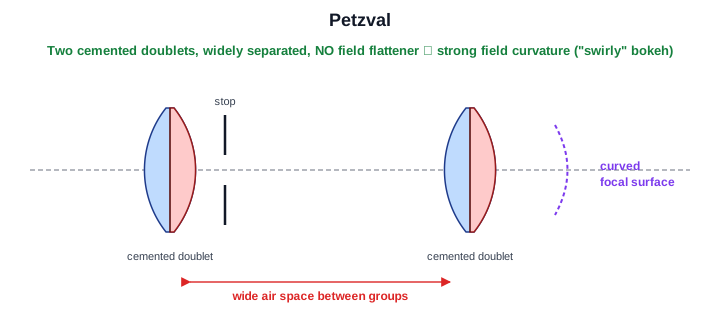
Petzval. Distinguishing trait: two cemented doublets, both with positive net power, separated by a wide air space, with no field flattener. The Petzval sum is therefore not corrected and the focal surface (purple) is curved – sharp at the centre, smearing into a characteristic “swirl” at the edges. The defect is now the feature.
Modern Aspheric / Floating-Element Designs
Contemporary photographic lenses, particularly mirrorless zooms and fast primes, are heavily computer-optimized derivatives that no longer fit neatly into one classical family. They typically include:
12 – 20 elements, several with aspheric surfaces;
low-dispersion (ED / FK / fluorite) and high-index glasses;
one or more floating groups that move at different rates during focus or zoom, to keep aberrations corrected at all distances and focal lengths;
internal focus and image stabilization groups.
When you see such a prescription in the table, the family label is mostly historical. The optimizer, not a single classical layout, is doing the work.
Photographic Family Summary
Family |
Elements |
Groups |
Typical use |
Distinguishing trait |
|---|---|---|---|---|
Double Gauss |
6 – 8 |
4 – 6 |
Fast normals (50 mm f/1.4) |
Symmetry around the stop; doublet on each side |
Tessar |
4 |
3 |
Compact moderate-aperture primes |
+, –, cemented (+,–) behind the stop |
Sonnar |
6 – 7 |
3 – 4 |
Fast portrait / short tele |
Few air-glass surfaces; thick cemented groups |
Cooke Triplet |
3 |
3 |
Cheap primes, projector lenses |
+, –, + air-spaced; minimum corrected design |
Retrofocus |
varies |
2 main |
SLR wide-angles |
Negative group in front, positive behind |
Telephoto |
varies |
2 main |
Long lenses |
Positive front, negative rear; length < EFFL |
Petzval |
4 |
2 |
Portrait, art bokeh |
Two widely-spaced cemented doublets |
Modern aspheric zoom |
12 – 20 |
6 – 10 |
Most current lenses |
Floating groups, aspherics, ED glass |
Machine Vision Lens Families
Machine-vision lenses are designed to a different cost function. The relevant priorities are usually:
low geometric distortion (often < 0.1 % for metrology);
high MTF uniformly across the sensor, not just on-axis;
fixed focus and aperture, mechanically locked against vibration;
compatibility with C, CS, F, or large-format industrial mounts;
in many cases, telecentricity, so that magnification does not change with object distance.
Aperture speed and weight, which dominate photographic design, are typically secondary.
Fixed-Focal-Length (FFL) Industrial Lenses
Most general-purpose machine-vision FFL lenses (the C-mount lenses sold by Edmund, Kowa, Fujinon, Schneider, Tamron, Computar, and so on) are still Double Gauss derivatives or close cousins. The symmetry is a free distortion-suppressor, which matters when the lens will be used for measurement, not photography. They differ from photographic Double Gauss lenses mainly in:
fixed (often locked) iris and focus rings;
lower maximum aperture (f/2.8 or f/4 is common);
tighter mechanical tolerances and athermalized barrels;
spectral correction extended into NIR, or restricted to a narrow band.
Retrofocus On Large Sensors
Short focal lengths on large machine-vision sensors (1.1”, 4/3”, APS-C-sized line scan) often need a retrofocus layout simply to give enough mechanical back-focal distance for the C/F-mount flange and any filter or prism in front of the sensor. The same negative-front / positive-rear topology used in SLR wide-angles applies.
Telecentric Lenses
Telecentric lenses are the signature optic of machine vision and are not common in photography at all. In an object-space telecentric lens, the aperture stop is placed at the rear focal point of the front group, so the chief rays in object space are parallel to the optical axis. The practical consequence is that magnification does not change with object distance: a part that is slightly closer or farther than nominal still images at the same size. This is essential for non-contact dimensional measurement.
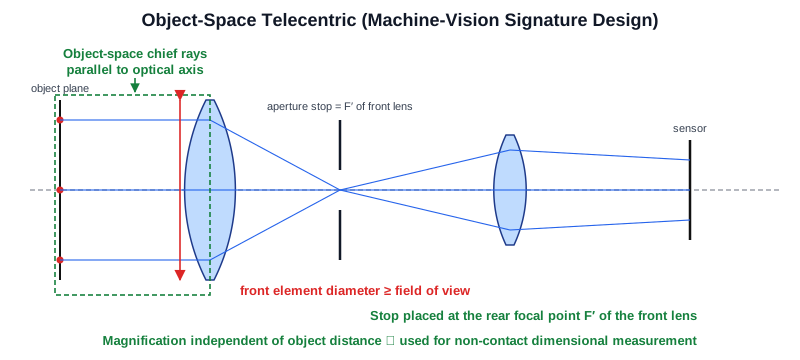
Object-space telecentric. Distinguishing trait: the aperture stop is
placed at the rear focal point F' of the front group. As a direct
consequence (highlighted in green), the chief rays in object space – one
from each object point – are parallel to the optical axis. The physical
give-away (highlighted in red) is that the front element diameter must be
at least as large as the field of view, which is why telecentric lenses
are big, heavy, and unmistakable in a parts catalogue.
Distinguishing physical traits:
the front element diameter must be at least as large as the field of view – telecentric lenses for a 100 mm field have a 100+ mm front element and are large, heavy, and expensive;
long, tubular barrels;
very narrow useful working-distance range (often quoted ±5 % of nominal);
sometimes bi-telecentric (telecentric in both object and image space), which additionally stabilizes magnification against sensor placement.
Fixed-Magnification Macro / Inspection Lenses
Many vision tasks need a specific magnification at a specific working distance, not infinity focus. Vendors sell lenses specified directly as e.g. “0.5× at 110 mm WD”. These are typically symmetric or near-symmetric designs optimized at that conjugate, and they perform poorly if used away from it. In KrakenOS terms, they are designed with a finite object distance as part of the prescription rather than the usual infinite-conjugate convention.
Line-Scan Lenses
Line-scan sensors are very long and very narrow (e.g. 8k × 1 pixels). The lens only needs to image one line, but it must do so over a wide field with extremely uniform MTF. Designs tend to be large-format-style, often near-symmetric process-lens descendants, and are usually specified by image circle (e.g. “82 mm image circle”) rather than by 35 mm-equivalent focal length.
Spectrally Specialized Lenses
UV, SWIR, and broadband VIS-NIR lenses are usually not a different topology from the families above; they use the same Double Gauss / retrofocus / telecentric layouts but with carefully chosen glasses (fused silica, CaF2, sapphire, special crowns) and coatings tuned for the target band. A “SWIR Double Gauss” is still recognizably a Double Gauss in the prescription.
Machine Vision Family Summary
Family |
Typical layout |
Typical use |
Distinguishing trait |
|---|---|---|---|
FFL industrial |
Double Gauss derivative |
General machine vision, 8 – 75 mm focal lengths |
Locked focus / iris, low distortion, robust barrel |
Wide-FOV industrial |
Retrofocus |
Short focal length on large sensors |
Negative front group, long back focus |
Telecentric |
Front group with stop at F’ |
Gauging, metrology, alignment |
Front element ≥ FOV; magnification independent of WD |
Bi-telecentric |
Telecentric on both sides |
High-precision metrology |
Stable against both object and sensor displacement |
Fixed-magnification macro |
Symmetric finite-conjugate |
PCB / part inspection at fixed WD |
Specified by magnification + WD, not focal length |
Line-scan |
Large-format symmetric |
Web inspection, document scanning |
Specified by image circle; very wide flat field |
UV / SWIR / NIR |
Any of the above |
Spectroscopy, hyperspectral, thermal |
Special glasses and coatings, same topology |
Photography vs. Machine Vision: Side by Side
Concern |
Photography |
Machine vision |
|---|---|---|
Aperture speed |
Often dominant – f/1.4 to f/2.8 is the goal |
Secondary – f/2.8 to f/8 is common, often fixed |
Distortion |
Tolerated and corrected in software |
Hard requirement, often < 0.1 % |
Off-axis MTF |
Allowed to drop toward edges |
Required to stay high across the whole sensor |
Working distance |
Continuously variable focus |
Often a single fixed WD per lens |
Telecentricity |
Practically never used |
Common, sometimes mandatory |
Mechanical stability |
Manual / autofocus rings, light barrel |
Locked rings, athermalized, vibration-tolerant |
Spectral range |
Visible only, with anti-IR coating |
Visible, NIR, SWIR, UV depending on application |
Typical front-element size |
Driven by aperture (entrance pupil) |
Driven by field of view (telecentric) or aperture |
Family of choice |
Double Gauss, retrofocus, telephoto, modern zooms |
Double Gauss derivatives, retrofocus, telecentric |
Reading A Prescription In KrakenOS
When you load or build a system in the KrakenOS editable table, the family usually reveals itself within the first inspection:
count the elements (rows of glass material) and the groups (consecutive rows separated by AIR);
find the aperture stop;
check whether the layout is symmetric around the stop (Double Gauss, classical Planar, fixed-magnification macro);
check whether the front group is negative (retrofocus) or the rear group is negative (telephoto);
check whether the stop sits at the rear focal point of the front group (telecentric).
Once the family is identified, the intent of every variable in the table
becomes much easier to reason about. Optimization variables, paraxial solves,
and merit operands such as EFFL or Spot RMS (introduced in the
tutorials) can then be applied with the correct expectation of which
aberrations the family already controls and which it does not.
Further Reading
For deeper treatments of these families and their derivations, the standard references are:
Smith, Modern Lens Design, McGraw-Hill;
Smith, Modern Optical Engineering, McGraw-Hill;
Kingslake & R. B. Johnson, Lens Design Fundamentals, Academic Press;
Laikin, Lens Design, CRC Press.
These books give exact prescriptions for many of the layouts sketched above, which can be entered directly into the KrakenOS editable table as a starting point for further work.