Case Study 7: Mach-Zehnder Two-Output Interferometer
Goal
This case study demonstrates a cascaded beam-splitter workflow:
load a Mach-Zehnder layout with two physical output ports;
read the five path labels in the 2D plot;
isolate each output port with
Path view;run detector, coherent detector, interferogram, and branch-field analyses;
verify that the return output port is also available for analysis.
The screenshots in this tutorial are generated from the live Tk UI with:
python -m KrakenOS.UI.capture_mach_zehnder_case_study_screenshots
Load The Mach-Zehnder Layout
Start the UI with
python -m KrakenOS.UI.layout_editor.Choose
Layouts -> Beam Splitters / Folds -> Mach-Zehnder Interferometer (Interferogram).Keep
Trace mode = Non-Sequential Preview.Keep
NS probabilistic coating splitoff.
This layout uses two deterministic 50/50 beam splitters. BS1 splits the
input source into the upper transmitted arm and lower reflected arm. BS2
recombines those two arms and sends light to two detector ports.
The Object row is a scene/reference datum. Rays launch from the physical
Source panel, so source position, radius, direction, power, and ray count
control this example.
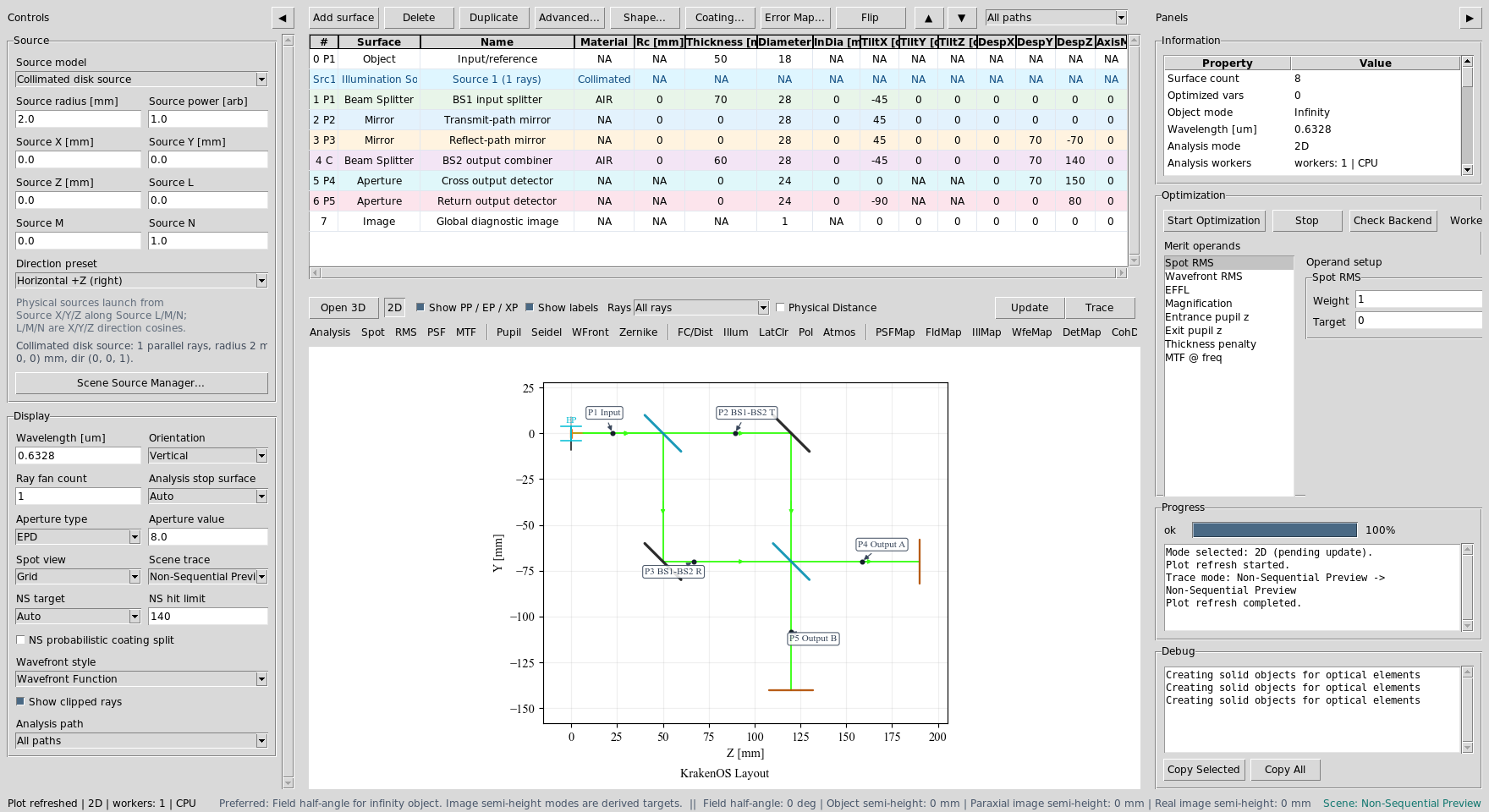
The preset contains a physical source, BS1, two fold mirrors, BS2,
a cross-output detector, and a return-output detector.
Read The Path Labels
Click Update. With the default chief-ray source, the 2D plot is intended to
read like a schematic. The black-dot labels identify the physical path
segments where the user can reason about adding optical components.
Plot label |
Meaning |
|---|---|
|
Source to |
|
|
|
|
|
Cross output from |
|
Return output from |
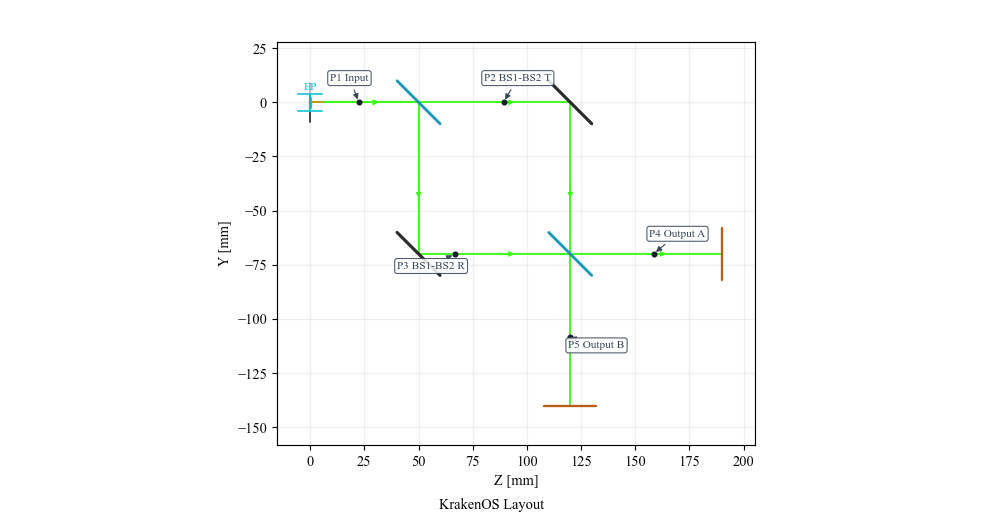
Path labels follow physical legs, not only branch codes. This is the
convention used by the table Path view dropdown.
Use Path View For Each Output
After Update, open the table toolbar Path view dropdown and select:
Path 4: BS2 to cross output detector
This filters the table and plot to the common path plus output detector A.
This is the path where branch codes RT and TR recombine.
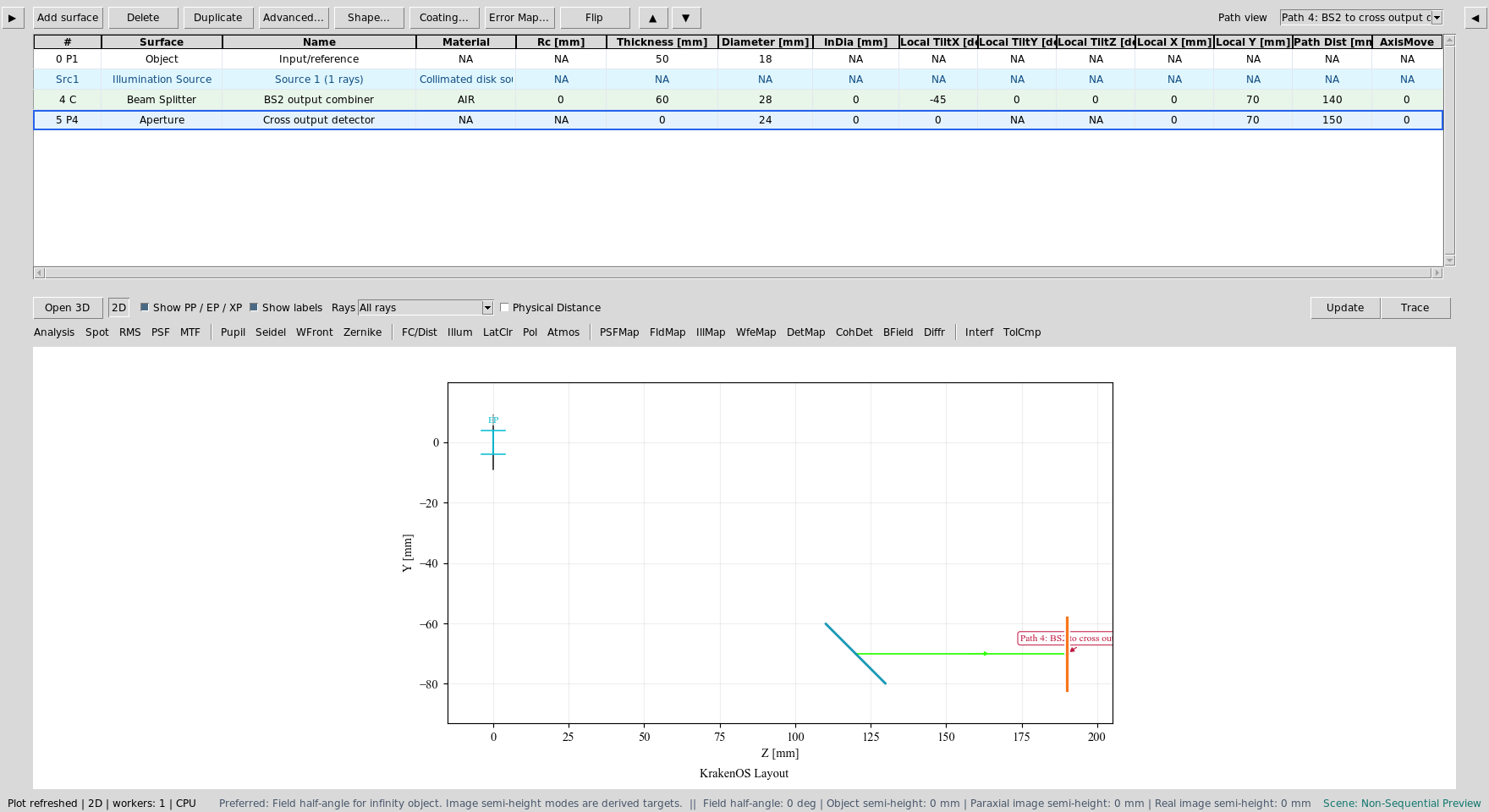
Path view isolates output A without renumbering the underlying KrakenOS
surface rows.
Now select:
Path 5: BS2 to return output detector
This filters the table and plot to the common path plus output detector B.
This is the path where branch codes RR and TT recombine.
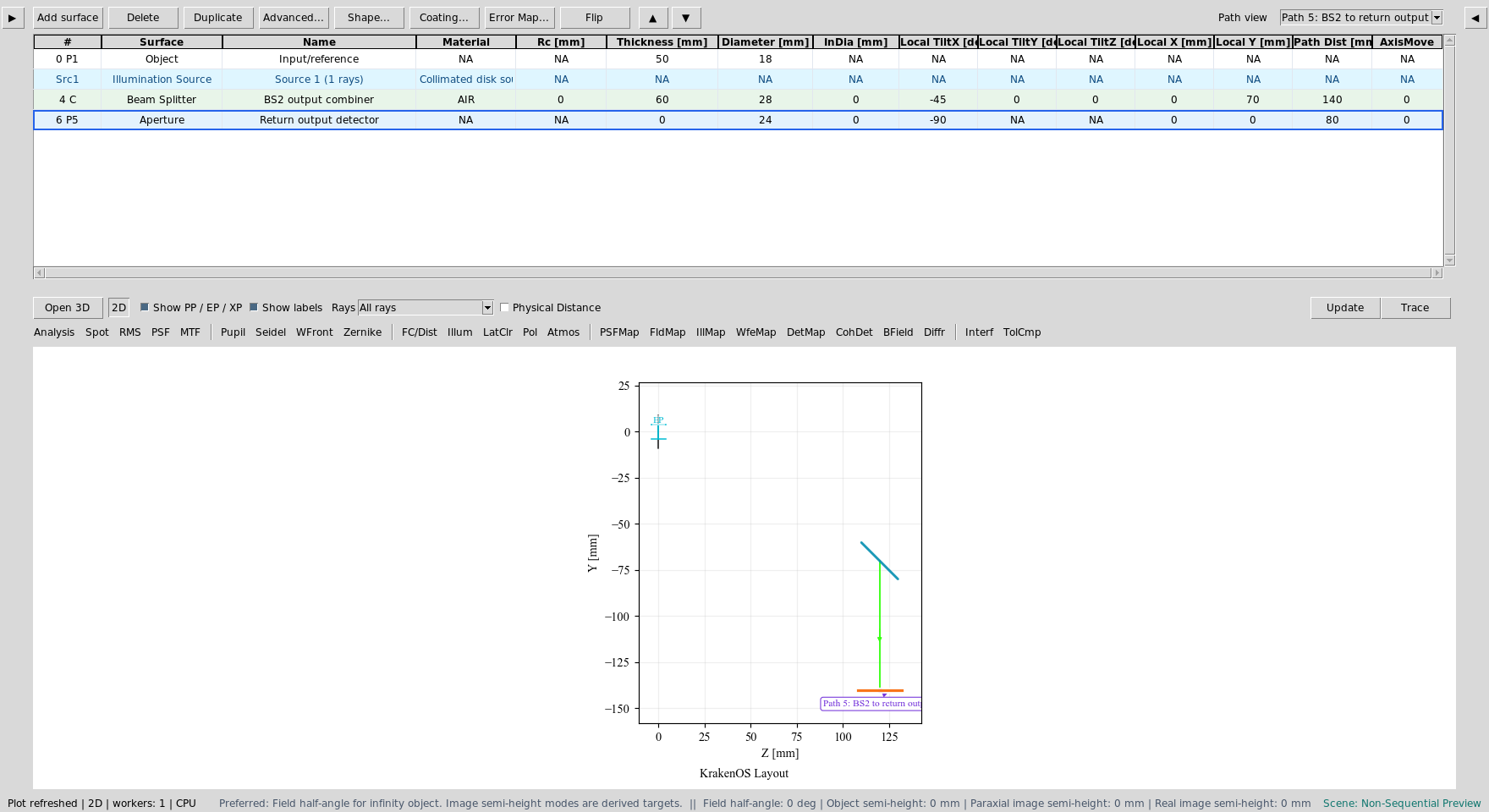
Output B is a separate detector path, so it can be inspected and optimized independently from output A.
Run Detector Analyses
For analysis screenshots, use a denser source bundle:
Ray fan count = 121
Source radius [mm] = 4.0
Detector bins = 128
Coherent sum = Mutual coherent
Path view = All paths
Analysis path = Output: Detector output port
Click DetMap and Update. This maps detector power at output A.
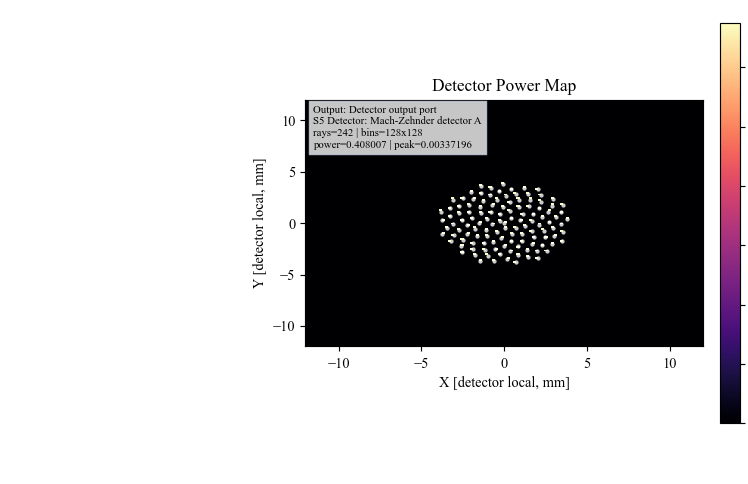
DetMap verifies that both recombining branches reach detector A.
Click CohDet and Update. This uses the same detector hits but sums the
complex Jones field by coherence group instead of only summing power.
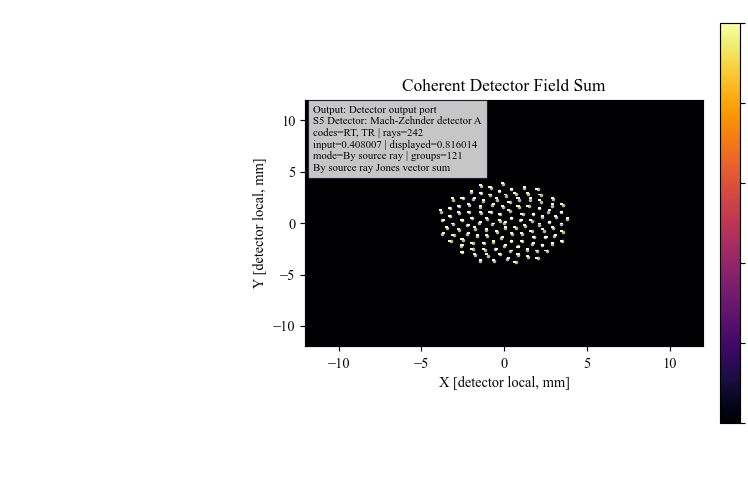
CohDet reports the detector, branch codes, ray count, and polarization
model used for the coherent sum.
Show The Interferogram
Click Interf and Update.
The Mach-Zehnder preset stores interferogram settings on BS2. The
interferogram analysis uses the selected detector-output branch family and the
saved detector settings to display a detector-bin coherent interferogram.
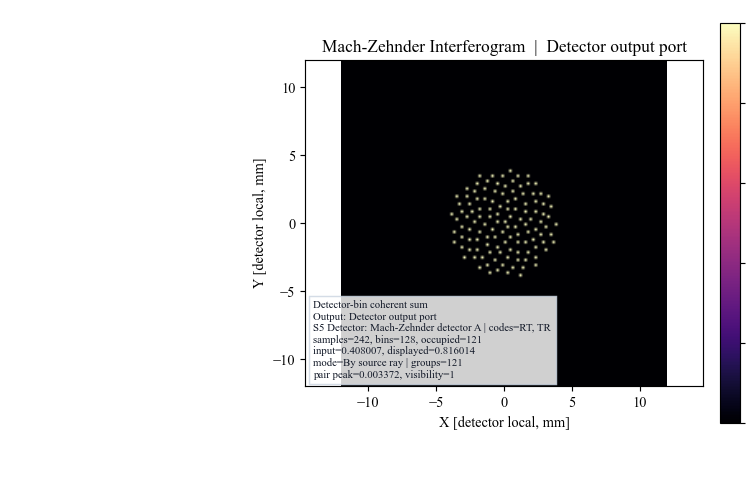
The plotted interferogram is sampled from traced detector hits. Increase source samples and detector bins when a smoother display is needed.
Run Branch Field
Set BField z [mm] = 0. Click BField and Update.
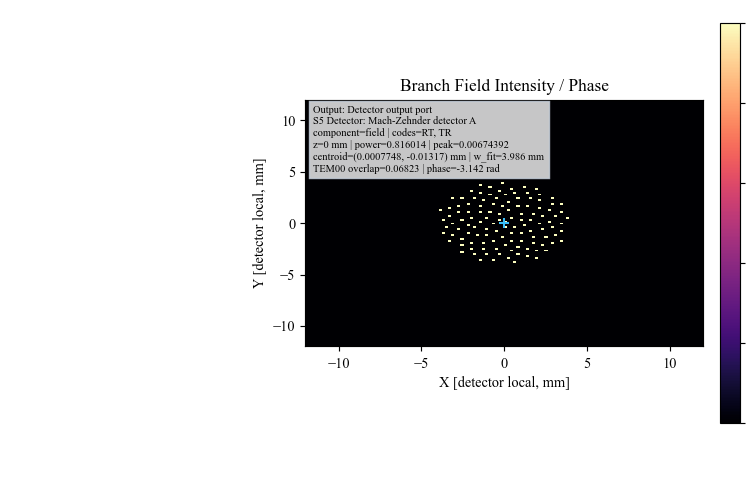
BField promotes the coherent detector samples into a branch-field grid
and reports intensity, phase, centroid, and mode diagnostics.
Check The Return Output
Change only the analysis filter:
Analysis path = Output: Source return port
Click CohDet and Update. Output B uses the complementary branch pair,
so its branch codes differ from output A.
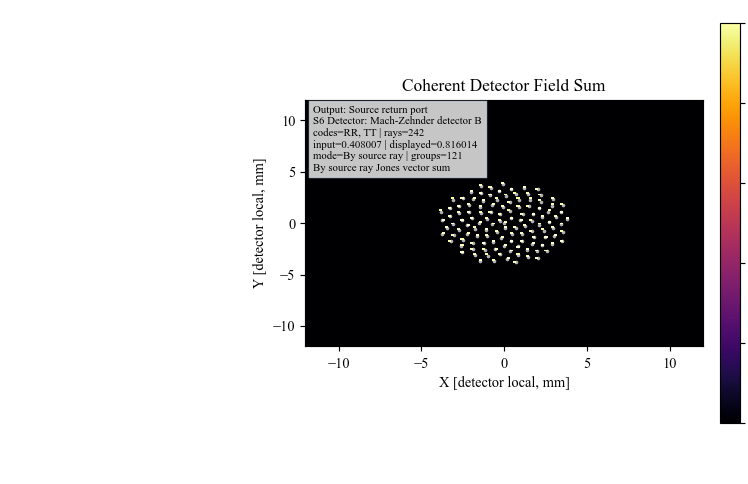
The return-output detector is a first-class analysis target, not a hidden byproduct of the cross-output port.
What This Proves
This case study exercises the non-sequential beam-splitter workflow beyond the single-output Michelson example:
cascaded beam splitters;
source/object separation;
five physical path labels in the 2D plot;
table filtering by each physical output path;
two detector output ports;
detector power analysis;
coherent field recombination;
interferogram generation;
branch-field intensity/phase analysis.
Common Mistakes
I expected Path view to show only one branch code.Path view follows physical legs. A detector-output leg can contain multiple recombining branch codes.
I selected All paths for coherent analysis and got the wrong output.For a two-output interferometer, use
Analysis pathto choose the output port before running coherent detector, interferogram, or branch-field views.The detector pattern is sparse.Increase
Ray fan countandDetector binsfor analysis. KeepRay fan count = 1when you want the clean schematic view.The Object row moved but the source did not.This preset launches from the Source panel. Move the source controls when you want to move illumination.