Analysis Tools (Layout Editor Toolbar)
The Analysis row of the KrakenOS Layout Editor toolbar exposes 23 toggleable analyses that
plot data on top of the editable layout. Their button labels and tooltip text
are defined in KrakenOS/UI/layout_editor.py near
mode_button_groups / mode_tooltips. This page collects the theory
behind each tool — the equation(s) it evaluates and what the resulting figure
represents — together with a schematic SVG of the typical output.
The toolbar groups them into five clusters, reflected by the section ordering below:
Geometric image quality — Spot, RMS, PSF, MTF
Pupil and wavefront — Pupil, Seidel, WFront, Zernike
Field-dependent metrics — FC/Dist, Illum, LatClr, Pol, Atmos
Map analyses on the detector / pupil — PSFMap, FldMap, IllMap, WfeMap, DetMap, CohDet, BField, Diffr
Comparative analyses — Interf, TolCmp
Symbol conventions
Symbols that recur throughout the page:
Symbol |
Meaning |
|---|---|
\((u, v)\) |
Normalised pupil coordinates, \(u^{2} + v^{2} \le 1\). Stored as
|
\((\rho, \theta)\) |
Polar form of the pupil coordinates: \(\rho = \sqrt{u^{2}+v^{2}}\), \(\theta = \arg(u + iv)\). |
\((x, y)\) |
Cartesian coordinates on the image / detector plane, in millimetres. |
\((x_{f}, y_{f})\) |
Field-point coordinates (object-space angle in degrees or object
height in mm, set by |
\(h\) |
Generic field magnitude — image height (mm) for finite objects, field angle (rad or deg) for objects at infinity. |
\(\lambda\) |
Wavelength, in millimetres (matches the rest of the KrakenOS system units). |
\(k\) |
Vacuum wavenumber, \(k = 2\pi/\lambda\). |
\(n_{1}, n_{2}\) |
Refractive indices on the incident and transmitted sides of an interface. |
\(F/\#\) |
Working F-number, \(F/\# = f' / D_{\mathrm{EP}}\). |
\(f, f'\) |
Front / rear effective focal lengths
( |
\(D_{\mathrm{stop}}, D_{\mathrm{EP}}, D_{\mathrm{XP}}\) |
Diameters of the aperture stop, entrance pupil and exit pupil. |
\(W(u, v)\) |
Optical-path-difference (OPD) wavefront in the exit pupil, in waves (multiples of \(\lambda\)) or in millimetres depending on the plot. |
\(P(u, v)\) |
Pupil-amplitude function. Unit on the open pupil, zero outside; complex-valued if apodization or polarization loss is included. |
\(z\) |
Axial distance from the exit pupil to the image plane. |
\(\boldsymbol{\nu} = (\nu_{x}, \nu_{y})\) |
Spatial frequency vector on the image plane (cycles / mm). |
\(\nu_{c}\) |
Diffraction cut-off frequency, \(\nu_{c} = 1/(\lambda\,F/\#)\). |
\(E(x, y)\) |
Complex scalar field amplitude on a surface; irradiance is \(|E|^{2}\). |
\(w_{i}\) |
Radiometric weight (power, or \(|E|^{2}\,\Delta A\)) carried by traced ray \(i\). |
\(\mathrm{OPL}_{i}\) |
Optical path length accumulated by ray \(i\) along its path, \(\mathrm{OPL}_{i} = \sum_{\ell} n_{\ell}\,s_{\ell}\). |
\(\langle \cdot \rangle\) |
Average of the quantity over the pupil area (or the relevant integration domain). |
Using analyses as optimization targets
Each analysis on this page is also a candidate merit-function operand: the
optimizer (Optimization / Solves and the Optimization panel) drives a chosen
variable until the analysis value reaches a target. The workflow is always the
same — (1) pick the analysis that captures your requirement, (2) expose the
right variables (radii, thicknesses, glasses, tilts), (3) set the analysis
value as the target operand, and (4) iterate. The three tables below answer:
which analysis to target, what value to aim for, and what you give up when you
push it.
Some tools are diagnostics rather than direct targets — Pupil, the map analyses (PSFMap, FldMap, IllMap, WfeMap, DetMap, BField), and Interf are read to decide what to target, then you optimize the corresponding scalar metric (RMS, Wavefront, MTF, Illum…).
Why each analysis matters and when to target it
Analysis |
Why it matters (what it tells you) |
Make it the optimization target when… |
Typical target / pass criterion |
|---|---|---|---|
Geometric blur size from ray aberrations; the fastest read of focus and aberration balance. |
Early design or focusing, while blur is far larger than the Airy disc (geometry-limited). |
RMS spot \(\le\) Airy radius, or \(\le\) one sensor pixel. |
|
One-number sharpness versus field — the merit-function workhorse. |
Balancing sharpness across the whole field, not just on axis. |
RMS held \(\le\) Airy / pixel at every field point. |
|
The true diffraction image of a point; reveals energy concentration (Strehl) that geometry misses. |
Near the diffraction limit, where spot size alone is misleading. |
Strehl ratio \(\ge 0.8\) (≈ \(\lambda/4\) wavefront). |
|
Contrast versus spatial frequency — the headline imaging spec customers quote. |
A sensor resolution / contrast requirement exists. |
MTF \(\ge\) spec at the sensor Nyquist (e.g. \(\ge 0.3\)). |
|
Transverse ray-fan / pupil-aberration plot — diagnoses which aberration dominates. |
Not a direct target; read it to choose which aberration to attack. |
Ray-fan slopes flat and symmetric. |
|
Third-order coefficients (spherical, coma, astigmatism, Petzval, distortion) — the analytic design “knobs”. |
Balancing primary aberrations term-by-term. |
Drive or balance a specific \(S_j \to 0\) (against higher order). |
|
OPD map — the physical limit on diffraction performance. |
Diffraction-limited imaging or interferometry. |
\(\le \lambda/4\) PV (Rayleigh) or \(\le \lambda/14\) RMS (Maréchal). |
|
Orthogonal-mode decomposition of the wavefront; isolates named aberrations and feeds PSF/MTF. |
Attacking specific modes (e.g. minimise spherical, coma). |
RMS of fitted terms small; each target mode below tolerance. |
|
Field curvature bows the focal surface; distortion bends straight lines. |
Flat sensors (curvature) or metrology / machine vision (distortion). |
Field sag within depth of focus; \(|\text{distortion}| \le\) spec (≈ <0.1 % metrology, <2–3 % consumer). |
|
Relative illumination (vignetting + \(\cos^4\theta\)) — edge brightness falloff. |
Uniformity or radiometry matters. |
Relative illumination \(\ge\) spec at the corner (e.g. \(\ge\) 50 %). |
|
Lateral color = wavelength-dependent magnification → colored edges. |
Color sensors, especially over a wide field. |
Lateral color \(\le\) 1 pixel across the field. |
|
Diattenuation and retardance through the system. |
Polarization-sensitive systems (LCoS, interferometry, polarimetry). |
Retardance / diattenuation below spec. |
|
Atmospheric dispersion / refraction shifts the color image. |
Ground telescopes and long slant paths (ADC design). |
Residual dispersion < resolution / seeing. |
|
PSF over the field grid — field-dependent image quality at a glance. |
Verifying uniform quality across the sensor (diagnostic). |
PSF / Strehl uniform within spec across the field. |
|
A per-field map of a chosen metric. |
Diagnostic — pick the operand and confirm it everywhere. |
Mapped metric within spec across the field. |
|
Two-dimensional illumination across the detector. |
Radiometric uniformity over the whole sensor (not just a meridian). |
Corner-to-corner roll-off within spec. |
|
Wavefront error across the field. |
Field-dependent diffraction performance. |
WFE \(\le \lambda/4\) over the used field. |
|
Power / irradiance landing on the detector (non-sequential). |
Stray-light and energy budgeting. |
Collected power \(\ge\) budget; ghosts below threshold. |
|
Coherent sum of fields → interference and fringe visibility. |
Interferometers and coherent beam combination. |
Fringe visibility / contrast \(\ge\) spec. |
|
The field on a chosen non-sequential branch (split paths). |
Validating each arm of a splitter / multi-path system. |
Each branch carries the intended energy and quality. |
|
Diffraction pattern at the detector. |
Diffraction-dominated detectors (pinhole, grating order). |
Order / spot energy within spec. |
|
Simulated interferogram (fringes \(\propto\) OPD) — how the part looks on a test interferometer. |
Designing for testability or a null test. |
Interpretable fringe count; null where intended. |
|
Nominal versus perturbed performance — manufacturability and robustness. |
Finalising for build (the tolerance budget). |
As-built performance \(\ge\) spec at the target yield. |
Conflicting objectives — what you give up
Optical design is a balance: pushing one analysis almost always costs another. A merit function with several weighted operands lets the optimizer find the compromise instead of over-correcting one metric. The common trades:
Push this… |
…and this tends to degrade |
Why (physics) / what to watch |
|---|---|---|
Faster system (lower \(F/\#\), more light) |
Spherical aberration, wavefront, Strehl |
Spherical grows roughly as aperture3; opening the stop trades sharpness for speed. Watch Spot — Spot Diagram, WFront — Wavefront Analysis, MTF — Modulation Transfer Function. |
Wider field of view |
Coma, astigmatism, field curvature, lateral color, illumination |
Off-axis aberrations and edge falloff all grow with field height. Watch RMS — RMS Spot Radius vs field, FC/Dist — Field Curvature / Distortion, LatClr — Lateral Color, Illum — Relative Illumination. |
Flat field (low Petzval) |
Element count / track length, axial color |
Field flatteners add negative elements and chromatic load. Watch Petzval \(S_{IV}\) in Seidel — Seidel Aberrations and the track length. |
Low distortion |
Astigmatism and field curvature at wide field |
The mapping correction fights the off-axis field aberrations (and can cost telecentricity / illumination). Watch FC/Dist — Field Curvature / Distortion. |
High MTF at Nyquist |
Depth of focus, tolerance margin, low-frequency MTF |
A peaky high-frequency response is defocus- and fabrication-sensitive. Watch through-focus MTF and TolCmp — Tolerance Compare. |
More relative illumination (less vignetting) |
Off-axis spot / MTF |
Vignetting was discarding the worst marginal rays; keeping them re-introduces aberration. Balance Illum — Relative Illumination against RMS — RMS Spot Radius vs field. |
Diffraction-limited wavefront / high Strehl |
Manufacturability, spectral bandwidth |
A tight null is sensitive to figure and alignment errors and to wavelength. Watch TolCmp — Tolerance Compare and WfeMap — Wavefront Error Map across \(\lambda\). |
Corrected lateral color |
Axial color, glass-choice freedom |
Apochromatic balancing constrains the glass map and can add elements. Watch LatClr — Lateral Color against axial color. |
Compact track length |
Aberration headroom (Seidel balancing) |
Fewer, closer elements give the optimizer less freedom to balance terms. Watch Seidel — Seidel Aberrations and RMS — RMS Spot Radius. |
Worked case studies: from a poor start to best
The tutorials carry two end-to-end optimizations that start from a deliberately poor design and drive an analysis value to a good one. The numbers below are the values those case studies actually report, so you can reproduce them click for click.
Case study |
Metric (target operand) |
Poor start |
Best (after) |
How it was achieved |
|---|---|---|---|---|
Focus a machine-vision lens (Case Study 2) |
On-axis Spot RMS |
1.21 mm |
0.0022 mm |
Best-focus solve moves the sensor (S5 rear datum) to ≈ 308.3 mm with
|
Focus a machine-vision lens (Case Study 2) |
MTF @ 20 cyc/mm |
0.008 |
0.90 |
The same focus solve — one variable (image distance), one operand. |
Cooke triplet from a bad start (Case Study 17) |
Spot RMS @ 0.55 µm (axis & 3°) |
> 1 mm |
< 0.01 mm |
Optimizer varies the radii and airspaces with |
Cooke triplet from a bad start (Case Study 17) |
MTF @ 20 cyc/mm |
≈ 0 (no useful contrast) |
usable contrast |
The same multi-variable optimization recovers contrast at the reference frequency. |
To learn the analysis panels themselves on a single well-behaved design before optimising, see One lens, many analyses (Case Study 18, which walks Spot → PSF → MTF → Wavefront → Zernike), and for the robustness side of the table above, Tolerance Monte Carlo and compensators (Case Study 11) exercises TolCmp.
Geometric image quality
Spot — Spot Diagram
Plots ray intercepts at the analysis surface (or the system image plane) for the currently selected fields and wavelengths. For \(N\) traced rays with hit coordinates \((x_i, y_i)\) the centroid and geometric RMS spot radius are
where
\(N\) is the number of rays that reached the analysis surface (after vignetting),
\((x_i, y_i)\) are the image-plane coordinates of ray \(i\) (mm),
\((\bar{x}, \bar{y})\) is the unweighted spot centroid (mm),
\(\sigma_{\mathrm{RMS}}\) is the geometric RMS spot radius (mm).
The geometric reference is the Airy radius
where \(\lambda\) is the wavelength and \(F/\#\) the working F-number. When \(\sigma_{\mathrm{RMS}} \lesssim r_{\mathrm{Airy}}\) the spot is dominated by diffraction rather than geometric aberration.
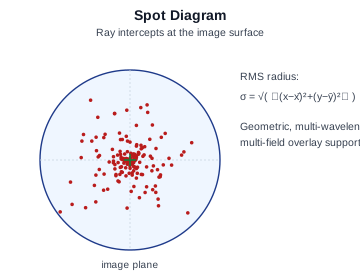
Worked example. Three rays land at \((x_1, y_1) = (0.10,\, 0.05)\), \((x_2, y_2) = (-0.04,\, 0.08)\), \((x_3, y_3) = (0.02,\, -0.12)\) mm.
\(\bar{x} = (0.10 - 0.04 + 0.02)/3 = 0.0267\) mm, \(\bar{y} = (0.05 + 0.08 - 0.12)/3 = 0.0033\) mm.
per-ray squared offsets: \(d_1^{2} = 0.0733^{2} + 0.0467^{2} = 0.00755\), \(d_2^{2} = 0.0667^{2} + 0.0767^{2} = 0.01032\), \(d_3^{2} = 0.0067^{2} + 0.1233^{2} = 0.01526\) mm².
\(\sigma_{\mathrm{RMS}} = \sqrt{(0.00755 + 0.01032 + 0.01526)/3} = \sqrt{0.01104} \approx 0.1051\) mm = 105 µm.
Airy radius at \(\lambda = 0.5876\) µm, \(F/\# = 8\): \(r_{\mathrm{Airy}} = 1.22 \cdot 0.5876 \cdot 8 = 5.73\) µm.
\(\sigma_{\mathrm{RMS}} / r_{\mathrm{Airy}} \approx 18\) → geometrically limited, not diffraction-limited.
KrakenOS code:
Rays = Kos.raykeeper(Doublet)
x, y, z, L, M, N = Pup.Pattern2Field()
for i in range(len(x)):
    Doublet.Trace([x[i], y[i], z[i]], [L[i], M[i], N[i]], W)
    Rays.push()

X, Y, *_ = Rays.pick(-1)             # ray landings on image surface
xbar, ybar = np.mean(X), np.mean(Y)
sigma_rms  = np.sqrt(np.mean((X - xbar)**2 + (Y - ybar)**2))
print(f"centroid = ({xbar:.4f}, {ybar:.4f}) mm")
print(f"sigma_RMS = {sigma_rms*1e3:.2f} um")
print(f"r_Airy   = {1.22 * W * Fno:.2f} um")
RMS — RMS Spot Radius
Computes \(\sigma_{\mathrm{RMS}}(h)\) for a swept field point \(h\) and plots one curve per wavelength,
where
\(h\) is the field magnitude (image height in mm for finite objects, field angle in degrees for objects at infinity — see
Pup.FieldType),\(\lambda\) is the wavelength of the traced bundle,
\(N(h, \lambda)\) is the number of rays that reach the image at that field/wavelength,
\((x_{i}, y_{i})\) and \((\bar{x}, \bar{y})\) are defined as in Spot — Spot Diagram.
Useful as a quick proxy for image quality across the field without forming a full PSF.
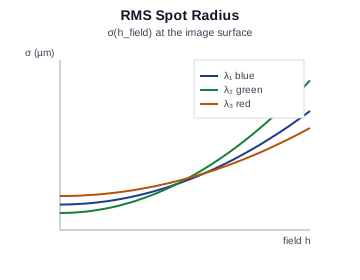
Worked example. Suppose a Seidel-dominated lens has approximately \(\sigma_{\mathrm{RMS}}(h) = a + b\,h^{2}\) with \(a = 4\) µm, \(b = 5.25\,\mu\mathrm{m}\,/\,\mathrm{deg}^{2}\).
On axis (\(h = 0\)): \(\sigma_{\mathrm{RMS}}(0) = 4\) µm.
At \(h = 2°\): \(\sigma_{\mathrm{RMS}}(2) = 4 + 5.25 \cdot 4 = 25\) µm.
Ratio: \(\sigma_{\mathrm{RMS}}(2) / \sigma_{\mathrm{RMS}}(0) = 6.25\times\) — typical quadratic blow-up dominated by oblique spherical / coma.
KrakenOS code:
fields = np.linspace(0.0, 2.0, 9)     # field angles (deg)
sigma  = []
for h in fields:
    Pup.FieldX, Pup.FieldY = 0.0, float(h)
    Rays = Kos.raykeeper(Doublet)
    x, y, z, L, M, N = Pup.Pattern2Field()
    for i in range(len(x)):
        Doublet.Trace([x[i], y[i], z[i]], [L[i], M[i], N[i]], W)
        Rays.push()
    X, Y, *_ = Rays.pick(-1)
    sigma.append(np.sqrt(np.mean((X - X.mean())**2 + (Y - Y.mean())**2)))

for h, s in zip(fields, sigma):
    print(f"h = {h:.2f} deg  sigma_RMS = {s*1e3:.2f} um")
PSF — Point Spread Function
The image-plane irradiance produced by a point source. With the Fraunhofer / Fourier-optics formulation,
where
\((x, y)\) are the Cartesian image-plane coordinates (mm),
\((u, v)\) are normalised exit-pupil coordinates,
\(P(u, v)\) is the pupil-amplitude function (1 inside the pupil, 0 outside, optionally complex if apodization / polarization losses are included),
\(W(u, v)\) is the OPD wavefront in the exit pupil (mm),
\(k = 2\pi/\lambda\) is the vacuum wavenumber,
\(\lambda\) is the wavelength (mm),
\(z\) is the axial distance from exit pupil to image plane (mm).
The diffraction-limited case (\(W \equiv 0\)) is the Airy pattern with central radius
with \(F/\#\) the working F-number of the converging bundle.
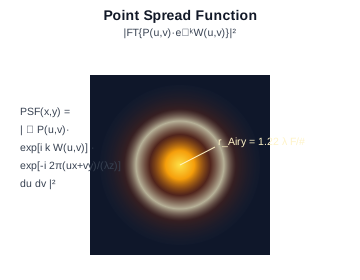
Worked example. Diffraction-limited (\(W \equiv 0\)) circular pupil at \(\lambda = 0.5876\) µm, \(F/\# = 8\), \(f = 80\) mm, \(D_{\mathrm{EP}} = 10\) mm:
central Airy radius: \(r_{\mathrm{Airy}} = 1.22\,\lambda\,F/\# = 1.22 \cdot 0.5876 \cdot 8 \approx 5.73\) µm.
first-zero diameter \(= 2\,r_{\mathrm{Airy}} \approx 11.47\) µm.
peak irradiance (per unit input power) \(\propto (D_{\mathrm{EP}} / (\lambda f))^{2} = (10 / (0.0005876 \cdot 80))^{2} \approx (212.7\,\mathrm{mm}^{-1})^{2}\).
KrakenOS code:
# Fit the wavefront to Zernikes so we have a COEF vector to feed psf().
X, Y, Z, P2V = Kos.Phase2(Pup)
Zcoef, *_ = Kos.Zernike_Fitting(X, Y, Z, np.ones(15))

I = Kos.psf(Zcoef, Focal, Diameter, W,
            pixels=265, PupilSample=4, plot=1, sqr=1)
r_Airy_um = 1.22 * W * Fno
print(f"Airy radius = {r_Airy_um:.2f} um")
MTF — Modulation Transfer Function
Magnitude of the Optical Transfer Function (OTF), which is the autocorrelation of the generalised pupil:
where
\(\mathbf{u} = (u, v)\) are exit-pupil coordinates (mm),
\(\boldsymbol{\nu} = (\nu_{x}, \nu_{y})\) is the spatial-frequency vector on the image plane (cycles / mm),
\(P(\mathbf{u})\) is the pupil-amplitude function and \(P^{*}\) its complex conjugate,
\(W(\mathbf{u})\) is the wavefront error (mm),
\(k = 2\pi/\lambda\), \(\lambda\) is the wavelength (mm),
\(z\) is the exit-pupil-to-image distance (mm),
\(|\mathrm{OTF}(\boldsymbol{\nu})|\) is the contrast transmission at frequency \(\boldsymbol{\nu}\).
For a clear circular pupil the diffraction-limited MTF is
where
\(\nu = |\boldsymbol{\nu}|\) is the radial spatial frequency (cycles / mm),
\(\nu_{c} = 1/(\lambda\,F/\#)\) is the diffraction cut-off frequency (cycles / mm),
\(\phi\) is an auxiliary angle obtained from the cut-off-normalised frequency, in radians.
KrakenOS plots both tangential and sagittal MTF along with the diffraction-limited reference.
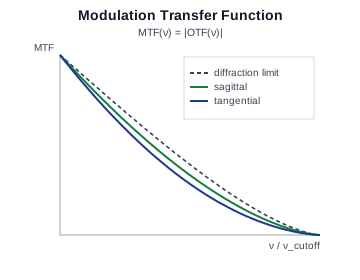
Worked example. \(\lambda = 0.5876\) µm, \(F/\# = 8\):
cut-off frequency \(\nu_{c} = 1 / (\lambda\,F/\#) = 1 / (0.0005876\,\mathrm{mm} \cdot 8) \approx 212.7\) cycles/mm.
At \(\nu = \nu_{c}/2\): \(\phi = \arccos(0.5) = \pi/3 \approx 1.047\) rad, \(\cos\phi\,\sin\phi = 0.5 \cdot 0.8660 = 0.4330\), \(\mathrm{MTF}_{\mathrm{DL}} = (2/\pi)(1.047 - 0.4330) \approx 0.391\).
At \(\nu = 0.2\,\nu_{c}\): \(\phi = \arccos(0.2) \approx 1.369\) rad, \(\mathrm{MTF}_{\mathrm{DL}} = (2/\pi)(1.369 - 0.196 \cdot 0.980) \approx 0.747\).
KrakenOS code:
X, Y, Z, P2V = Kos.Phase2(Pup)
Zcoef, *_ = Kos.Zernike_Fitting(X, Y, Z, np.ones(15))

mtf = Kos.calculate_mtf(Zcoef, Focal, Diameter, W,
                        pixels=265, PupilSample=4)
Kos.plot_mtf(mtf, Diameter, W, freq_limit=300)

nu_c = 1.0 / (W * 1e-3 * Fno)        # cycles per mm
print(f"diffraction cut-off = {nu_c:.1f} cy/mm")
Pupil and wavefront
Pupil — Pupil Diagnostic
Reports the entrance (EP) and exit (XP) pupil positions and diameters along the optical axis, plus the chief- and marginal-ray paths. KrakenOS computes the small-angle pupil magnifications
where
\(\theta_{0}\) is the half-angle subtended at the object by a small fan of rays launched from the optical axis (radians),
\(\theta_{\mathrm{stop}}\) is the half-angle the same fan subtends at the aperture-stop surface after being traced through the upstream optics,
\(\theta_{\mathrm{image}}\) is the half-angle the fan subtends at the final image surface after the full system trace,
\(m_{\mathrm{enter}}\) and \(m_{\mathrm{exit}}\) are therefore the angular magnifications from object space to the stop and from object space to image space.
See PupilCalc.__init__ in KrakenOS/PupilTool.py for the explicit
fan-of-rays construction. With a measured stop diameter
\(D_{\mathrm{stop}}\),
where
\(D_{\mathrm{stop}}\) is the clear-aperture diameter of the physical stop surface (mm),
\(D_{\mathrm{EP}}\) is the entrance-pupil diameter (mm) — the image of the stop as seen from object space,
\(D_{\mathrm{XP}}\) is the exit-pupil diameter (mm) — the image of the stop as seen from image space.
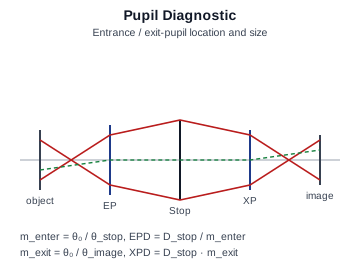
Worked example. Send a tiny fan with object-space half-angle \(\theta_{0} = 0.010\) rad. Suppose the upstream optics reduce the half-angle at the stop surface to \(\theta_{\mathrm{stop}} = 0.0083\) rad, and the full system expands it to \(\theta_{\mathrm{image}} = 0.0125\) rad. With a measured stop diameter \(D_{\mathrm{stop}} = 10.0\) mm:
\(m_{\mathrm{enter}} = 0.010 / 0.0083 \approx 1.205\).
\(m_{\mathrm{exit}} = 0.010 / 0.0125 = 0.800\).
\(D_{\mathrm{EP}} = 10.0 / 1.205 \approx 8.30\) mm.
\(D_{\mathrm{XP}} = 10.0 \cdot 0.800 = 8.00\) mm.
KrakenOS code:
# 1) Read the cardinal quantities produced by PupilCalc.
D_EP = 2.0 * Pup.RadPupInp
D_XP = 2.0 * Pup.RadPupOut
print(f"EP diameter = {D_EP:.3f} mm  at z = {Pup.PosPupInp}")
print(f"XP diameter = {D_XP:.3f} mm  at z = {Pup.PosPupOut}")
print(f"EFFL (f')   = {Pup.EFFL:.3f} mm")

# 2) Recover the small-angle pupil magnifications from the formula
#    D_EP = D_stop / m_enter,  D_XP = D_stop * m_exit.
D_stop      = Doublet.SDT[Surf].Diameter      # physical stop diameter (mm)
m_enter     = D_stop / D_EP
m_exit      = D_XP / D_stop
print(f"D_stop      = {D_stop:.3f} mm")
print(f"m_enter     = D_stop / D_EP = {m_enter:.4f}")
print(f"m_exit      = D_XP   / D_stop = {m_exit:.4f}")
print(f"working F/# = {Pup.EFFL / D_EP:.2f}")
Seidel — Seidel Aberrations
Per-surface sums of the third-order monochromatic aberration coefficients \(S_{\mathrm{I}}..S_{\mathrm{V}}\) and the first-order chromatic terms \(C_{\mathrm{I}}, C_{\mathrm{II}}\). The total wavefront aberration of the system as a polynomial in pupil and field is
where
\(W(u, v; h)\) is the OPD wavefront in the exit pupil for field \(h\) (waves),
\((u, v)\) are normalised pupil coordinates and \((\rho, \theta)\) their polar form (\(\rho^{2} = u^{2} + v^{2}\), \(\theta = \arg(u + i v)\)),
\(h\) is the field magnitude (image height or field angle),
\(S_{\mathrm{I}}\) is the spherical-aberration coefficient (\(\rho^{4}\) term),
\(S_{\mathrm{II}}\) is the coma coefficient (\(h \rho^{3}\) term),
\(S_{\mathrm{III}}\) is the astigmatism coefficient (\(h^{2} \rho^{2}\cos^{2}\theta\) term),
\(S_{\mathrm{IV}}\) is the Petzval field-curvature coefficient (\(h^{2} \rho^{2}\) term),
\(S_{\mathrm{V}}\) is the distortion coefficient (\(h^{3} \rho\) term),
\(C_{\mathrm{I}}, C_{\mathrm{II}}\) are the axial and lateral chromatic aberration coefficients (not shown in the polynomial above because they describe wavelength-dependent focal-length and magnification shifts rather than monochromatic OPD).
Each \(S_{k}\) is a sum over surfaces; KrakenOS plots the per-surface bars so the dominant contributor can be identified.
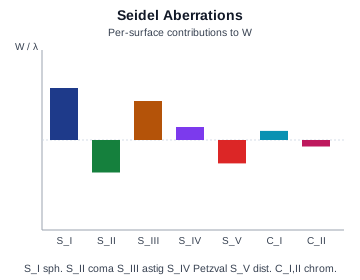
Worked example. Take \(S_{\mathrm{I}} = 0.50\), \(S_{\mathrm{II}} = -0.20\), \(S_{\mathrm{III}} = 0.30\), \(S_{\mathrm{IV}} = 0.10\), \(S_{\mathrm{V}} = -0.05\) (all in waves). Evaluate the OPD at \(\rho = 0.7\), \(\theta = 30°\), \(h = 2\):
\(S_{\mathrm{I}}\,\rho^{4} = 0.50 \cdot 0.2401 = +0.1200\)
\(S_{\mathrm{II}}\,h\,\rho^{3}\cos\theta = -0.20 \cdot 2 \cdot 0.343 \cdot 0.866 = -0.1188\)
\(S_{\mathrm{III}}\,h^{2}\,\rho^{2}\cos^{2}\theta = 0.30 \cdot 4 \cdot 0.49 \cdot 0.75 = +0.4410\)
\(S_{\mathrm{IV}}\,h^{2}\,\rho^{2} = 0.10 \cdot 4 \cdot 0.49 = +0.1960\)
\(S_{\mathrm{V}}\,h^{3}\,\rho\cos\theta = -0.05 \cdot 8 \cdot 0.7 \cdot 0.866 = -0.2425\)
Sum: \(W \approx +0.396\) waves at that pupil/field point — astigmatism dominates at this field height.
KrakenOS code:
AB = Kos.Seidel(Pup)
print("Seidel coefficients (S_I..S_V):", AB.SAC_TOTAL)
print("Seidel in waves (W040..W311) :", AB.SCW_TOTAL)
print("Transverse contributions     :", dict(zip(AB.TAC_NM, AB.TAC_TOTAL)))
print("Chromatic CL (axial) / CT (lateral):",
      np.sum(AB.CL), np.sum(AB.CT))
WFront — Wavefront Analysis
Computes the OPD \(W(u, v)\) of every traced ray relative to a reference sphere centred on the chief-ray intercept and plots a slice (or the full 2D map — see WfeMap). The key scalar summaries are
where
\(W(u, v)\) is the OPD wavefront in the exit pupil (waves),
\(\max(W), \min(W)\) are the maximum and minimum of \(W\) over the pupil,
\(\mathrm{PV}\) is the peak-to-valley wavefront error (waves),
\(\langle W \rangle = \frac{1}{\pi}\!\iint_{u^{2}+v^{2}\le 1} W(u, v)\,\mathrm{d}u\,\mathrm{d}v\) is the area-average of \(W\) over the pupil,
\(\mathrm{RMS}\) is the root-mean-square wavefront error (waves).
The Maréchal approximation links RMS to the Strehl ratio in the small-aberration limit (\(\mathrm{RMS}\lesssim \lambda/14\)):
where
\(S\) is the Strehl ratio, the on-axis PSF intensity normalised to the diffraction-limited value (dimensionless, \(0 < S \le 1\)),
\(\mathrm{RMS}\) and \(\lambda\) carry the same units (both in mm, or both in waves with \(\lambda = 1\)).
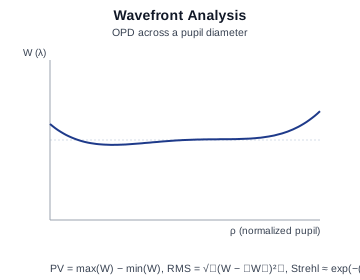
Worked example. Assume the pupil-sampled wavefront has \(\max(W) = +0.18\) waves, \(\min(W) = -0.12\) waves and \(\mathrm{RMS} = 0.050\) waves:
\(\mathrm{PV} = 0.18 - (-0.12) = 0.30\) waves.
Maréchal Strehl: \(S \approx \exp[-(2\pi \cdot 0.050)^{2}] = \exp(-0.0987) \approx 0.906\).
Convention check: the Maréchal “diffraction-limited” criterion \(\mathrm{RMS} \le \lambda/14 \approx 0.0714\) waves corresponds to \(S \gtrsim 0.82\); our 0.906 sits comfortably above that.
KrakenOS code:
X, Y, Z, P2V = Kos.Phase2(Pup)                      # Z is W in waves
PV   = Z.max() - Z.min()
RMS  = np.std(Z)
S    = np.exp(-(2.0 * np.pi * RMS) ** 2)
print(f"PV  = {PV:.4f} waves  (Phase2 reports P2V = {P2V:.4f})")
print(f"RMS = {RMS:.4f} waves   Strehl ~= {S:.3f}")
Zernike — Zernike Polynomial Fit
Expands the wavefront on the orthonormal Zernike basis over the unit disk,
where
\((\rho, \theta)\) are polar pupil coordinates, \(0 \le \rho \le 1\), \(0 \le \theta < 2\pi\),
\(j\) is the single-index ordering of the Zernike polynomials (Noll, OSA, or Fringe — KrakenOS reports which convention is used),
\(n\) is the radial order (non-negative integer),
\(m\) is the azimuthal frequency, an integer with \(|m| \le n\) and \(n - |m|\) even,
\(Z_{n}^{m}(\rho, \theta)\) is the Zernike polynomial of order \((n, m)\),
\(a_{j}\) is the expansion coefficient of mode \(j\) (waves), and is the quantity plotted in the bar chart.
The radial part \(R_{n}^{|m|}(\rho)\) is
where \(s\) is the dummy summation index (kept separate from the wavenumber \(k\)). Coefficients \(a_{j}\) are recovered by a linear least-squares fit to the sampled wavefront and displayed both as a bar chart and as a colour map of \(W(\rho, \theta)\).
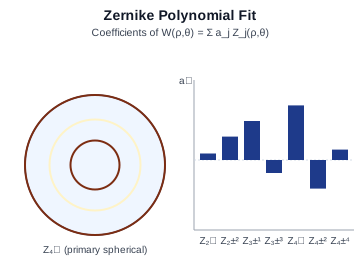
Worked example. Suppose a fit yields only \(a_{4}\,Z_{2}^{0}(\rho) = a_{4}(2\rho^{2} - 1)\) (defocus) with \(a_{4} = +0.30\) waves; all other coefficients negligible.
At \(\rho = 0\): \(W = +0.30 \cdot (-1) = -0.30\) waves.
At \(\rho = 1\): \(W = +0.30 \cdot (+1) = +0.30\) waves.
\(\mathrm{PV} = 0.60\) waves; the RMS of pure defocus is \(|a_{4}| / \sqrt{3} \approx 0.173\) waves (using \(\langle Z_{2}^{0\,2}\rangle_{\mathrm{disk}} = 1/3\)).
Strehl from defocus alone: \(S \approx \exp[-(2\pi \cdot 0.173)^{2}] \approx 0.305\).
KrakenOS code:
X, Y, Z, P2V = Kos.Phase2(Pup)
NC    = 15
A     = np.ones(NC)
Zcoef, Mat, RMS2Chief, RMS2Centroid, FE = Kos.Zernike_Fitting(X, Y, Z, A)
for i in range(NC):
    print(f"z{i+1:>2}  {float(Zcoef[i]):+ .6f}  {Mat[i]}")
print(f"RMS (to centroid) = {RMS2Centroid:.4f} waves")
print(f"fitting error     = {FE:.4f} waves")
Field-dependent metrics
FC/Dist — Field Curvature / Distortion
Two coupled plots:
Field curvature — the focus shift \(\Delta z_{\mathrm{focus}}(h) = z_{\mathrm{best}}(h) - z_{\mathrm{paraxial}}\), split into tangential (T, meridional fan best focus) and sagittal (S, sagittal fan best focus) branches; \(z_{\mathrm{best}}(h)\) is the axial position of the minimum-spot-radius image surface at field \(h\), \(z_{\mathrm{paraxial}}\) is the paraxial image-plane position.
Distortion — the radial deviation of the real image height from the paraxial value:
where
\(h\) is the (paraxial-defined) field magnitude — image height in mm for a finite object, or field angle in degrees for an object at infinity,
\(h_{\mathrm{paraxial}}(h)\) is the image height predicted by the paraxial (first-order) trace,
\(h_{\mathrm{real}}(h)\) is the chief-ray landing height obtained by the full real-ray trace,
\(\mathrm{distortion}(h)\) is the dimensionless percentage by which the real image deviates radially from the paraxial position.
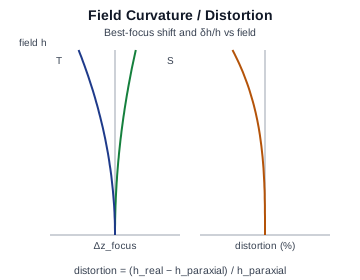
Worked example. Paraxial image height at \(h = 5°\) for an \(f' = 80\) mm lens is \(h_{\mathrm{paraxial}} = f' \tan h = 80 \tan(5°) = 6.998\) mm. Suppose the real chief ray lands at \(h_{\mathrm{real}} = 6.892\) mm and the best-focus surface curves by \(\Delta z_{\mathrm{best}}(5°) = -0.42\) mm (tangential branch, image-side focus drift):
\(\mathrm{distortion}(5°) = (6.892 - 6.998) / 6.998 \approx -1.51\%\) (barrel).
Defocus at edge of field: \(\Delta z = -0.42\) mm → corresponds to \(\lambda/(8\,(F/\#)^{2})\)-style depth-of-focus units of \(-0.42 / (8 \cdot 8^{2} \cdot 0.5876 \cdot 10^{-3}) \approx -1.40\) Rayleigh units — significant for diffraction-limited imaging.
KrakenOS code:
This snippet evaluates both parts of the formula above — the
field-curvature focus shift \(\Delta z_{\mathrm{focus}}(h)\) (from
Kos.BestFocus) and the distortion \((h_{\mathrm{real}} -
h_{\mathrm{paraxial}})/h_{\mathrm{paraxial}}\):
fields = np.linspace(0.0, 5.0, 11)
saved_p = Pup.Ptype

for h in fields:
    Pup.FieldX, Pup.FieldY = 0.0, float(h)

    # -- (a) field curvature: best-focus axial shift ----------------
    Pup.Ptype = "fan"                                # tangential fan
    Rays = Kos.raykeeper(Doublet)
    x, y, z, L, M, N = Pup.Pattern2Field()
    for i in range(len(x)):
        Doublet.Trace([x[i], y[i], z[i]], [L[i], M[i], N[i]], W)
        Rays.push()
    X, Y, Z, Lp, Mp, Np = Rays.pick(-1)
    dz_focus = float(Kos.BestFocus(X, Y, Z, Lp, Mp, Np))

    # -- (b) distortion: chief-ray height vs paraxial ---------------
    Pup.Ptype = "chief"
    Rays = Kos.raykeeper(Doublet)
    x, y, z, L, M, N = Pup.Pattern2Field()
    Doublet.Trace([x[0], y[0], z[0]], [L[0], M[0], N[0]], W)
    Rays.push()
    Xc, Yc, *_ = Rays.pick(-1)
    h_real  = float(np.hypot(Xc, Yc))
    h_parax = Focal * np.tan(np.deg2rad(h))
    d_pct   = (h_real - h_parax) / h_parax * 100 if h > 0 else 0.0

    print(f"h = {h:.1f} deg  Δz_focus = {dz_focus:+.4f} mm  "
          f"h_real = {h_real:.4f} mm  distortion = {d_pct:+.3f} %")

Pup.Ptype = saved_p
Illum — Relative Illumination
Image-plane irradiance normalised to the on-axis value:
where
\(\theta\) is the chief-ray field angle as measured from the optical axis (degrees or radians),
\(E(\theta)\) is the image-plane irradiance (W / mm²) at the chief-ray landing point for field angle \(\theta\),
\(E(0)\) is the on-axis irradiance,
\(\mathrm{RI}(\theta)\) is the relative illumination, a dimensionless ratio in \([0, 1]\).
For an ideal lens with no vignetting, geometric considerations yield the classical cos⁴ law:
The four cosine factors come from (i) projection of the entrance-pupil area, (ii) the inverse-square spread of pupil-to-image distance, (iii) projection of the image-pixel area, and (iv) the Lambertian cosine of incidence at the detector. KrakenOS overlays the measured curve, which also captures vignetting and pupil aberration, on top of that reference.
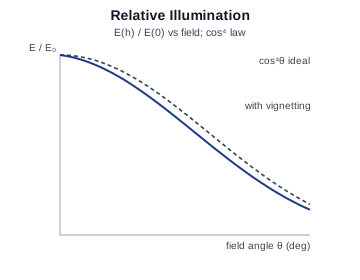
Worked example. Pure cos⁴ falloff, no vignetting:
\(\theta = 10°\): \(\cos^{4}\theta = 0.9848^{4} \approx 0.940\) → 94.0% of on-axis irradiance.
\(\theta = 20°\): \(\cos^{4}\theta = 0.9397^{4} \approx 0.780\) → 78.0%.
\(\theta = 30°\): \(\cos^{4}\theta = 0.8660^{4} \approx 0.563\) → 56.3%.
If the measured curve at \(\theta = 20°\) reads only 0.60 instead of the geometric 0.78, the vignetting fraction at that field is \(1 - 0.60/0.78 \approx 23\%\).
KrakenOS code:
Compute the irradiance in a small box around each chief-ray landing point (so the cos α projection is included), then take the ratio \(E(\theta)/E(0)\) — this matches the formula directly.
def irradiance_near_chief(theta_deg, n_rays=10_000, box=0.20):
    """Mean E = Σ w_i cos α_i / A around the chief-ray hit point."""
    # Chief ray = centre of the box.
    Pup.FieldX, Pup.FieldY = 0.0, float(theta_deg)
    Pup.Ptype = "chief"
    Rch = Kos.raykeeper(Doublet)
    x, y, z, L, M, N = Pup.Pattern2Field()
    Doublet.Trace([x[0], y[0], z[0]], [L[0], M[0], N[0]], W)
    Rch.push()
    xc, yc, *_ = Rch.pick(-1); xc, yc = float(xc), float(yc)

    # Filled pupil → irradiance estimate at the box around (xc, yc).
    Pup.Ptype = "rand"
    Pup.Samp  = int(np.sqrt(n_rays) / 2) + 1
    Rays = Kos.raykeeper(Doublet)
    x, y, z, L, M, N = Pup.Pattern2Field()
    launched = len(x)
    for i in range(launched):
        Doublet.Trace([x[i], y[i], z[i]], [L[i], M[i], N[i]], W)
        Rays.push()
    Xs, Ys, _, Ls, Ms, Ns = Rays.pick(-1)
    mask  = (np.abs(Xs - xc) < box/2) & (np.abs(Ys - yc) < box/2)
    power = np.sum(np.abs(Ns[mask]))         # Σ cos α_i, w_i = 1
    return power / (box * box) / launched    # E in (W / mm^2) per launched ray

E0 = irradiance_near_chief(0.0)
for h in (10.0, 20.0, 30.0):
    RI   = irradiance_near_chief(h) / E0
    cos4 = np.cos(np.deg2rad(h)) ** 4
    print(f"h = {h:.1f} deg  RI = {RI:.3f}   cos^4 ideal = {cos4:.3f}")
LatClr — Lateral Color
The transverse separation of chief-ray landing points between wavelengths,
where
\(h\) is the field magnitude (image height or field angle),
\(\lambda\) is the wavelength of the traced ray (mm),
\(\lambda_{0}\) is the reference wavelength against which other wavelengths are compared (typically the primary wavelength in the current spectrum),
\(y_{\mathrm{chief}}(\lambda, h)\) is the image-plane \(y\) coordinate of the chief ray for field \(h\) at wavelength \(\lambda\) (mm),
\(\Delta y_{\mathrm{lat}}(\lambda; h)\) is the lateral colour at field \(h\) for wavelength \(\lambda\) (mm); equivalently the chromatic difference of magnification.
The result is a coloured spread along the field direction.
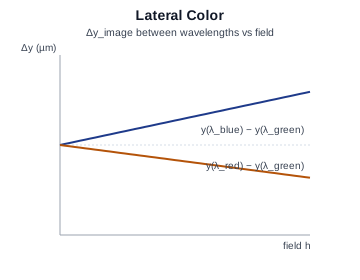
Worked example. At \(h = 2°\) the chief ray hits the image at:
\(\lambda_{0} = 0.5876\) µm (reference d-line): \(y_{\mathrm{chief}} = 6.9920\) mm
\(\lambda = 0.4861\) µm (F-line): \(y_{\mathrm{chief}} = 6.9985\) mm
\(\lambda = 0.6563\) µm (C-line): \(y_{\mathrm{chief}} = 6.9875\) mm
Then
\(\Delta y_{\mathrm{lat}}(0.4861;\,2°) = +6.5\) µm
\(\Delta y_{\mathrm{lat}}(0.6563;\,2°) = -4.5\) µm
total F-to-C spread \(= 11.0\) µm — for a 5 µm-pixel detector that is 2.2 pixels of colour fringe.
KrakenOS code:
Pup.FieldX, Pup.FieldY = 0.0, 2.0
Pup.Ptype = "chief"
bands = {"F":   0.4861,
         "d":   0.5876,
         "C":   0.6563}
y_chief = {}
for name, lam in bands.items():
    Rays = Kos.raykeeper(Doublet)
    x, y, z, L, M, N = Pup.Pattern2Field()
    Doublet.Trace([x[0], y[0], z[0]], [L[0], M[0], N[0]], lam)
    Rays.push()
    _, Y, *_ = Rays.pick(-1)
    y_chief[name] = float(Y)

y0 = y_chief["d"]
for name in ("F", "C"):
    print(f"Delta y_lat({name}) = {(y_chief[name] - y0)*1e3:+.2f} um")
Pol — Polarization
Tracks the Jones state \(\mathbf{E}_{\mathrm{out}} = J\,\mathbf{E}_{\mathrm{in}}\) through every interaction, applying the Fresnel coefficients at each surface,
where
\(\mathbf{E}_{\mathrm{in}}, \mathbf{E}_{\mathrm{out}}\) are the complex Jones vectors \((E_{s}, E_{p})^{T}\) of the incident and exit electric fields, decomposed into components perpendicular (\(s\)) and parallel (\(p\)) to the local plane of incidence,
\(J\) is the \(2 \times 2\) Jones matrix of the surface (or, by composition, of the whole system),
\(n_{1}, n_{2}\) are the refractive indices on the incident and transmitted sides of the interface,
\(\theta_{1}\) is the angle of incidence (between the ray and the surface normal, radians),
\(\theta_{2}\) is the angle of refraction, related to \(\theta_{1}\) by Snell’s law \(n_{1}\sin\theta_{1} = n_{2}\sin\theta_{2}\),
\(r_{s}, r_{p}\) are the amplitude reflection coefficients for the s- and p-polarizations; the corresponding power reflectances are \(R_{s} = |r_{s}|^{2}\), \(R_{p} = |r_{p}|^{2}\), and transmittances \(T_{s} = 1 - R_{s}\), \(T_{p} = 1 - R_{p}\).
The local s/p frame is rotated between surfaces to track polarization through the system. KrakenOS reports transmittance, diattenuation, and retardance; the Stokes vector
gives the degree of polarization
where
\(S_{0}\) is the total irradiance (any polarization state),
\(S_{1}\) is the difference between horizontal and vertical linearly polarized irradiance,
\(S_{2}\) is the difference between +45° and −45° linearly polarized irradiance,
\(S_{3}\) is the difference between right- and left-circularly polarized irradiance,
\(\mathrm{DoP} \in [0, 1]\) is the fraction of light that is polarized (1 = fully polarized, 0 = unpolarized).
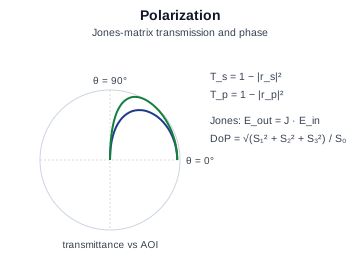
Worked example. Air → N-BK7 interface (\(n_{1} = 1.0\), \(n_{2} = 1.5\)) at \(\theta_{1} = 45°\). Snell:
\(\sin\theta_{2} = \sin 45° / 1.5 = 0.4714\) → \(\theta_{2} = 28.13°\).
\(\cos\theta_{1} = 0.7071\), \(\cos\theta_{2} = 0.8819\).
Fresnel coefficients:
\(r_{s} = (1.0 \cdot 0.7071 - 1.5 \cdot 0.8819) / (1.0 \cdot 0.7071 + 1.5 \cdot 0.8819) = -0.6158/2.0300 = -0.3033\), so \(R_{s} = 0.0920\), \(T_{s} = 0.9080\).
\(r_{p} = (1.5 \cdot 0.7071 - 1.0 \cdot 0.8819) / (1.5 \cdot 0.7071 + 1.0 \cdot 0.8819) = +0.1788/1.9426 = +0.0920\), so \(R_{p} = 0.00847\), \(T_{p} = 0.9915\).
Diattenuation at this interface \(= (T_{p} - T_{s}) / (T_{p} + T_{s}) \approx 0.044\).
KrakenOS code:
# Fresnel calculator that matches the formulas used inside KrakenOS.
def fresnel(n1, n2, theta1_deg):
    t1 = np.deg2rad(theta1_deg)
    s2 = (n1 / n2) * np.sin(t1)
    if abs(s2) > 1.0:
        return None                   # total internal reflection
    t2 = np.arcsin(s2)
    c1, c2 = np.cos(t1), np.cos(t2)
    rs = (n1*c1 - n2*c2) / (n1*c1 + n2*c2)
    rp = (n2*c1 - n1*c2) / (n2*c1 + n1*c2)
    return rs**2, rp**2, 1 - rs**2, 1 - rp**2

Rs, Rp, Ts, Tp = fresnel(1.0, 1.5, 45.0)
print(f"R_s={Rs:.4f}  T_s={Ts:.4f}")
print(f"R_p={Rp:.4f}  T_p={Tp:.4f}")

# System-level: in the |ui|, set surface coating + polarization input on
# the source, then read the Stokes vector / DoP from the polarization
# analysis. See KrakenOS/Examples/Examp_Beam_Splitter_Fresnel_Polarization.py
# for a full end-to-end sample.
Atmos — Atmospheric Dispersion
Bends each incoming ray by the wavelength-dependent atmospheric refraction reported by the AstroAtmosphere library (Ref. 3). A useful closed form is the Cassini approximation
where
\(R(z; \lambda)\) is the astronomical refraction: the angular deviation between the true and apparent direction of a star (arcseconds; positive bends the apparent position towards the zenith),
\(z\) is the zenith distance of the line of sight (radians; \(z = 0\) is straight up, \(z = 90°\) is the horizon),
\(\lambda\) is the wavelength (µm),
\(T\) is the air temperature (K),
\(P\) is the atmospheric pressure (Pa),
\(H\) is the relative humidity in \([0, 1]\),
\(x_{c}\) is the CO₂ concentration (ppm),
\(A\), \(B\) are the first and third Cassini coefficients — weak functions of \(\lambda\), \(T\), \(P\), \(H\), \(x_{c}\) and geographic latitude.
KrakenOS plots one curve per wavelength and uses the same model when
Pup.AtmosRef = 1 in PupilCalc (with the matching
Pup.l1, Pup.l2, Pup.T, Pup.P, Pup.H, Pup.xc, Pup.lat, Pup.h, Pup.z0
attributes documented in PupilCalc Tool).
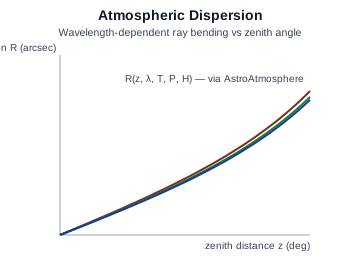
Worked example. Use round Cassini coefficients \(A = 60.4''\), \(B = 0.06''\) (standard atmosphere, mid-visible):
\(z = 30°\): \(\tan z = 0.5774\), \(R = 60.4 \cdot 0.5774 - 0.06 \cdot 0.5774^{3} = 34.86 - 0.012 \approx 34.85''\).
\(z = 45°\): \(\tan z = 1.0\), \(R = 60.4 - 0.06 = 60.34''\).
\(z = 60°\): \(\tan z = 1.7321\), \(R = 60.4 \cdot 1.7321 - 0.06 \cdot 1.7321^{3} = 104.62 - 0.312 \approx 104.31''\).
Between \(\lambda = 0.45\) µm and \(\lambda = 0.70\) µm, \(A\) typically differs by \(\sim 4''\) at sea level, so the atmospheric-dispersion smear at \(z = 45°\) is of order \(4''\) (about \(1.6\) µm on a 80-mm-focal lens).
KrakenOS code:
Two halves: (a) plug numbers into the Cassini formula so you can
verify the table above by hand, and (b) hand the same parameters to
PupilCalc for a self-consistent atmosphere-corrected ray launch.
# (a) Closed-form Cassini check ----------------------------------
def cassini_arcsec(z_deg, A_arcsec=60.4, B_arcsec=0.06):
    t = np.tan(np.deg2rad(z_deg))
    return A_arcsec * t - B_arcsec * t**3

for z in (30.0, 45.0, 60.0):
    print(f"z = {z:.0f} deg  R = {cassini_arcsec(z):.2f} arcsec")

# (b) AstroAtmosphere model inside PupilCalc ---------------------
Pup.AtmosRef = 1
Pup.T   = 283.15           # K
Pup.P   = 101300           # Pa
Pup.H   = 0.5              # relative humidity (0–1)
Pup.xc  = 400              # ppm CO2
Pup.lat = 31               # latitude (degrees)
Pup.h   = 2800             # observatory altitude (m)
Pup.l1  = 0.5876           # reference wavelength (µm)
Pup.l2  = 0.4861           # wavelength of interest (µm)
Pup.z0  = 45.0             # zenith distance (deg)
xa, ya, za, La, Ma, Na = Pup.Pattern2Field()
# Repeat with a different Pup.l2 to inspect the per-wavelength shift.
Map analyses on the detector / pupil
PSFMap — Point Spread Function Map
Renders the local PSF at a grid of field positions \((x_{f}, y_{f})\) — useful for visualising how aberrations (notably coma, astigmatism and field curvature) deform the spot across the field. Each cell evaluates
where
\((x_{f}, y_{f})\) are the field-point coordinates at which the local PSF is computed (object-space angles in degrees for objects at infinity, or object-plane heights in mm for finite objects),
\((x, y)\) are the local image-plane coordinates inside one PSF-cell (mm),
\((u, v)\) are normalised pupil coordinates,
\(P(u, v)\) is the pupil-amplitude function,
\(W(u, v;\, x_{f}, y_{f})\) is the field-dependent wavefront error for the chief ray of \((x_{f}, y_{f})\) (mm),
\(k = 2\pi/\lambda\) is the wavenumber,
\(\mathcal{F}\{\cdot\}\) denotes the 2D Fourier transform from pupil coordinates to image coordinates (an appropriate scale factor \(1/(\lambda z)\) is absorbed into \(\mathcal{F}\)).
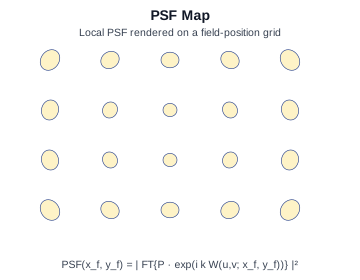
Worked example. A \(5 \times 5\) PSF map at 2° corner field has local Strehl values:
on-axis cell: \(S(0, 0) \approx 0.94\).
corner cell: \(S(2°, 2°) \approx 0.55\).
the field-averaged Strehl is the unweighted mean of the cells; if all 25 cells yielded the corner value, the system would already be below \(S = 0.8\) (the practical “well-corrected” threshold).
For each cell the local Airy radius is unchanged (\(r_{\mathrm{Airy}} = 5.73\) µm at \(F/\# = 8\), \(\lambda = 0.5876\) µm); it is the field-dependent \(W(u, v;\, x_{f}, y_{f})\) that broadens the spot.
KrakenOS code:
fx = np.linspace(-2.0, 2.0, 5)
fy = np.linspace(-2.0, 2.0, 5)
for yf in fy:
    for xf in fx:
        Pup.FieldX, Pup.FieldY = float(xf), float(yf)
        X, Y, Z, _ = Kos.Phase2(Pup)
        Zc, *_ = Kos.Zernike_Fitting(X, Y, Z, np.ones(15))
        I = Kos.psf(Zc, Focal, Diameter, W,
                    pixels=128, PupilSample=3, plot=0, sqr=1)
        Imax = float(np.max(I))
        print(f"field ({xf:+.1f},{yf:+.1f})  peak I = {Imax:.3e}")
FldMap — Field Map
Plots the real chief-ray image positions on a regular field grid and overlays the paraxial / ideal grid. The pointwise displacement vector
where
\((x_{f}, y_{f})\) are field-grid sampling coordinates (object angle or object height),
\(\mathbf{r}_{\mathrm{paraxial}}(x_{f}, y_{f}) = (x_{p}, y_{p})\) is the paraxial / ideal image-plane landing point (mm), computed from the first-order matrix model,
\(\mathbf{r}_{\mathrm{real}}(x_{f}, y_{f}) = (x_{r}, y_{r})\) is the real chief-ray landing point (mm), obtained by tracing the ray through every surface,
\(\Delta\mathbf{r}\) is the displacement (mm) from ideal to real.
The radial component of \(\Delta\mathbf{r}\) is distortion; the azimuthal component captures lateral colour and field-dependent decentre.
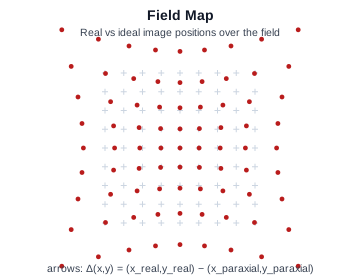
Worked example. Field-grid sample at \((x_{f}, y_{f}) = (3°, 4°)\), \(f' = 80\) mm. Paraxial chief-ray landing:
\(x_{p} = f' \tan(3°) = 80 \cdot 0.0524 = 4.195\) mm
\(y_{p} = f' \tan(4°) = 80 \cdot 0.0699 = 5.595\) mm
Real chief-ray landing (from full trace): \((x_{r}, y_{r}) = (4.150,\, 5.531)\) mm. Then
\(\Delta\mathbf{r} = (4.150 - 4.195,\, 5.531 - 5.595) = (-0.045,\, -0.064)\) mm.
Radial component (distortion): \((\Delta\mathbf{r}\cdot\hat{r}) = -0.078\) mm (\(|\hat{r}| = 1\), \(\hat{r}\) points from axis outward).
Tangential / azimuthal component: \(\approx 0\) (consistent with rotationally symmetric distortion).
KrakenOS code:
grid = np.linspace(-5.0, 5.0, 7)        # degrees
Pup.Ptype = "chief"
for yf in grid:
    for xf in grid:
        Pup.FieldX, Pup.FieldY = float(xf), float(yf)
        Rays = Kos.raykeeper(Doublet)
        x, y, z, L, M, N = Pup.Pattern2Field()
        Doublet.Trace([x[0], y[0], z[0]], [L[0], M[0], N[0]], W)
        Rays.push()
        X, Y, *_ = Rays.pick(-1)
        xp = Focal * np.tan(np.deg2rad(xf))
        yp = Focal * np.tan(np.deg2rad(yf))
        print(f"({xf:+.1f},{yf:+.1f})  real=({float(X):+.4f},{float(Y):+.4f})  "
              f"d=({float(X)-xp:+.4f},{float(Y)-yp:+.4f}) mm")
IllMap — Illumination Map
A 2D irradiance heat map on the detector,
where
\((x, y)\) are the detector-plane coordinates of the pixel centre (mm),
\(E(x, y)\) is the irradiance on that pixel (W / mm²),
\(\Phi\) is the radiant power (W) and \(\mathrm{d}A\) an area element of the pixel (mm²),
\(\mathrm{pixel}(x, y)\) is the set of traced rays whose intersection with the detector falls inside the pixel at \((x, y)\),
\(w_{i}\) is the per-ray radiometric weight (W) carried by ray \(i\) after all upstream transmittances, vignetting and apodization,
\(\alpha_{i}\) is the angle of incidence between ray \(i\) and the pixel surface normal (radians); the \(\cos\alpha_{i}\) factor projects the ray’s power onto the pixel area,
\(A_{\mathrm{pix}}\) is the area of one pixel (mm²).
The map captures cos⁴ falloff, vignetting, caustics and lens hot-spots in a single picture.
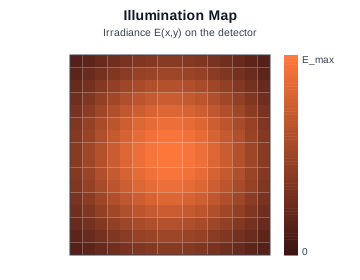
Worked example. Pixel pitch \(p = 5\) µm (\(A_{\mathrm{pix}} = 25 \cdot 10^{-6}\) mm²); a single pixel collects 12 traced rays each of weight \(w_{i} = 1.0\) µW landing at incidence angle \(\alpha_{i} = 10°\). Then
If the on-axis pixel reads \(E_{0} = 0.612\) W/mm² with the same trace, the local relative illumination is \(0.473/0.612 = 0.773\) — matching the cos⁴ prediction for a 20° off-axis field point.
KrakenOS code:
# Build an irradiance map by histogramming ray landings into pixels.
def illum_map(theta_deg, n_rays=20_000, pitch=0.005, half_extent=2.0):
    Pup.FieldX, Pup.FieldY = 0.0, float(theta_deg)
    Pup.Ptype = "rand"
    Pup.Samp  = int(np.sqrt(n_rays) / 2) + 1
    Rays = Kos.raykeeper(Doublet)
    x, y, z, L, M, N = Pup.Pattern2Field()
    for i in range(len(x)):
        Doublet.Trace([x[i], y[i], z[i]], [L[i], M[i], N[i]], W)
        Rays.push()
    X, Y, _, Lp, Mp, Np = Rays.pick(-1)
    cos_a = np.abs(Np)
    bins = np.arange(-half_extent, half_extent + pitch, pitch)
    H, *_ = np.histogram2d(X, Y, bins=bins, weights=cos_a)
    return H / (pitch ** 2)            # W per mm^2 per unit input ray weight

E20 = illum_map(20.0)
E0  = illum_map(0.0)
print(f"peak E(20 deg) / peak E(0 deg) = {E20.max() / E0.max():.3f}")
WfeMap — Wavefront Error Map
The 2D analogue of WFront: a colour map of \(W(u, v)\) over the exit pupil. The same PV / RMS / Strehl summaries apply,
where
\(W(u, v)\) is the OPD wavefront over the unit-disk exit pupil (waves),
\(u^{2} + v^{2} \le 1\) is the integration domain (open pupil),
\(1/\pi\) is the area of the unit disk in the denominator (so \(\langle\,\cdot\,\rangle\) is a true area-average),
\(\langle W \rangle = \frac{1}{\pi}\!\iint_{u^{2}+v^{2}\le 1} W\,\mathrm{d}u\,\mathrm{d}v\) is the pupil-average wavefront,
\(\mathrm{PV}\) and \(\mathrm{RMS}\) are as in WFront — Wavefront Analysis.
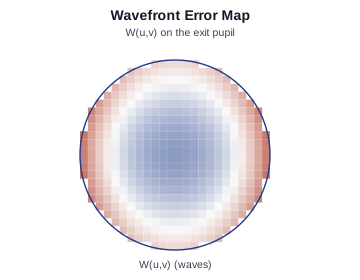
Worked example. Suppose the WFE map is pure defocus, \(W(u, v) = 0.30\,(2\rho^{2} - 1)\) waves with \(\rho^{2} = u^{2} + v^{2}\):
\(\max W = 0.30 \cdot (+1) = +0.30\) at the pupil edge, \(\min W = 0.30 \cdot (-1) = -0.30\) at the centre, so \(\mathrm{PV} = 0.60\) waves.
\(\langle W \rangle = 0\) (defocus is mean-free).
\(\mathrm{RMS}^{2} = \frac{1}{\pi}\!\iint_{\rho\le 1}(0.30)^{2}(2\rho^{2}-1)^{2}\, \mathrm{d}A = 0.09 \cdot \frac{1}{3} = 0.030\) → \(\mathrm{RMS} = 0.173\) waves, in agreement with Zernike — Zernike Polynomial Fit.
KrakenOS code:
X, Y, Z, P2V = Kos.Phase2(Pup)            # Z is W in waves
print(f"PV   (Phase2)          = {P2V:.4f} waves")
print(f"PV   (recomputed)      = {Z.max() - Z.min():.4f} waves")
print(f"<W>                    = {Z.mean():+.4f} waves")
print(f"RMS  (about mean)      = {np.sqrt(np.mean((Z - Z.mean())**2)):.4f} waves")

# Optional: render the map as a heat plot
import matplotlib.pyplot as plt
plt.scatter(X, Y, c=Z, s=12); plt.axis("equal"); plt.colorbar(label="W (waves)")
plt.title("Wavefront error map"); plt.show()
DetMap — Detector Power Map
Bins the incoherent power of each landed ray into detector pixels:
where
\((k, l)\) are the integer column / row indices of a detector pixel,
\(\mathrm{pixel}(k, l)\) is the set of traced rays whose detector intersection falls into that pixel,
\(w_{i}\) is the radiometric weight (W) carried by ray \(i\) after all upstream losses,
\(P_{kl}\) is the total incoherent power (W) deposited in pixel \((k, l)\).
Used for radiometric / throughput analyses and to detect stray-light
hot spots. CohDet (next) replaces the sum with a coherent one.
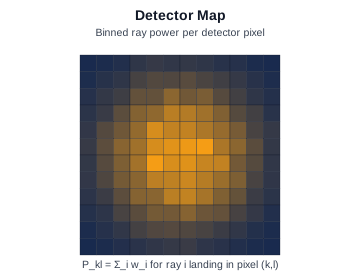
Worked example. A 5×5 µm pixel collects 8 rays of weight \(w_{i} = 1.0\) µW each:
\(P_{kl} = 8 \cdot 1.0 = 8.0\) µW.
Equivalent irradiance on that pixel (incoherent): \(E = 8.0\,\mu\mathrm{W} / (25 \cdot 10^{-6}\,\mathrm{mm}^{2}) = 3.2 \cdot 10^{5}\,\mathrm{\mu W/mm^{2}} = 0.32\)W/mm².
Contrast with the coherent sum (CohDet — Coherent Detector Field Sum) — if all 8 rays were perfectly in phase, the coherent intensity would scale as \((\sum \sqrt{w_{i}})^{2} = (8\sqrt{1.0})^{2} = 64\) µW² (units differ; coherent uses \(|E|^{2}\) not \(P\)).
KrakenOS code:
pitch       = 0.005                          # mm
half_extent = 2.0                            # mm
bins        = np.arange(-half_extent, half_extent + pitch, pitch)

Rays = Kos.raykeeper(Doublet)
x, y, z, L, M, N = Pup.Pattern2Field()
for i in range(len(x)):
    Doublet.Trace([x[i], y[i], z[i]], [L[i], M[i], N[i]], W)
    Rays.push()
X, Y, *_ = Rays.pick(-1)

w = np.ones_like(X)                          # uniform 1.0 weights
P, *_ = np.histogram2d(X, Y, bins=bins, weights=w)
k, l = np.unravel_index(np.argmax(P), P.shape)
print(f"hottest pixel (k={k}, l={l}) carries P_kl = {P.max():.2f} ray weights")
CohDet — Coherent Detector Field Sum
Replaces the incoherent sum in DetMap with a coherent sum of complex amplitudes carried along each ray (including OPL, transmittance and polarization phase),
where
\((k, l)\) are the detector-pixel indices (same as in DetMap),
\(\mathrm{pixel}(k, l)\) is the set of rays landing in that pixel,
\(w_{i}\) is ray \(i\)’s radiometric weight; its square root acts as a complex-amplitude magnitude,
\(k_{\lambda} = 2\pi/\lambda\) is the wavenumber (the subscript \(\lambda\) distinguishes it from the pixel index \(k\)),
\(\mathrm{OPL}_{i} = \sum_{\ell} n_{\ell}\,s_{\ell}\) is the optical path length accumulated along ray \(i\) over all segments, with \(n_{\ell}\) the segment index and \(s_{\ell}\) the segment geometric length (mm),
\(\varphi_{i}\) is any additional phase picked up by ray \(i\) (e.g. Fresnel reflection phase, polarization rotation, grating order phase), in radians,
\(I_{kl}\) is the resulting coherent intensity in pixel \((k, l)\) (W).
This reveals interferometric fringes from two-beam recombination (Mach–Zehnder, Michelson, etc.), speckle, and any other coherent effects the trace can resolve.
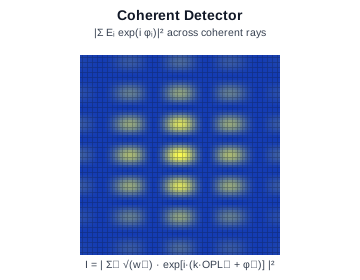
Worked example. Two coherent rays land in the same pixel with equal weights \(w_{1} = w_{2} = 1.0\), no extra phase (\(\varphi_{i} = 0\)), and OPLs differing by exactly half a wavelength (\(\mathrm{OPL}_{2} - \mathrm{OPL}_{1} = \lambda/2\)). Set \(k_{\lambda}\,\mathrm{OPL}_{1} = 0\) for convenience:
coherent sum: \(A = \sqrt{1}\,e^{i \cdot 0} + \sqrt{1}\,e^{i\pi} = 1 - 1 = 0\), \(I_{kl} = |A|^{2} = 0\) — fully destructive.
incoherent sum (DetMap): \(P_{kl} = 1 + 1 = 2\).
Now flip the OPL difference to a whole wavelength (\(k_{\lambda}\Delta\mathrm{OPL} = 2\pi\)):
\(A = 1 + 1 = 2\), \(I_{kl} = 4\) — constructive, twice what incoherent addition would give.
Fringe visibility for two unit-weight rays: \(V = 2\sqrt{w_{1}w_{2}}/(w_{1}+w_{2}) = 1\) (perfect fringes).
KrakenOS code:
# Toy coherent-sum at one pixel, fed by two rays with controlled OPL.
lam       = W * 1e-3                          # wavelength in mm
k_lambda  = 2.0 * np.pi / lam
w         = np.array([1.0, 1.0])
OPL       = np.array([10.000, 10.000 + lam / 2])   # half-wave apart
phi       = np.zeros_like(OPL)

A         = np.sum(np.sqrt(w) * np.exp(1j * (k_lambda * OPL + phi)))
I_coh     = np.abs(A) ** 2
P_inc     = np.sum(w)
print(f"incoherent sum P_kl = {P_inc:.2f}")
print(f"coherent   sum I_kl = {I_coh:.4f}")
BField — Branch Field
For Gaussian-branch sources, plots the on-axis intensity \(|E(x)|^{2}\) and phase \(\arg E(x)\) of the propagated field along the current branch, together with a fitted TEM₀₀ Hermite–Gauss template. The mode-overlap efficiency is
where
\(x\) is the transverse coordinate on the analysis surface along the branch (mm),
\(E(x)\) is the complex scalar field of the propagated bundle on that surface; \(E^{*}\) is its complex conjugate,
\(u_{\mathrm{TEM}_{00}}(x)\) is the fitted TEM₀₀ template — a fundamental Hermite–Gauss mode with the same wavelength, waist and pointing as the measured field,
\(\mathrm{d}A\) is an area element on the analysis surface,
\(\eta \in [0, 1]\) is the mode-overlap efficiency (also called the coupling efficiency): the fraction of the measured field’s power that lies in the fundamental Gaussian mode.
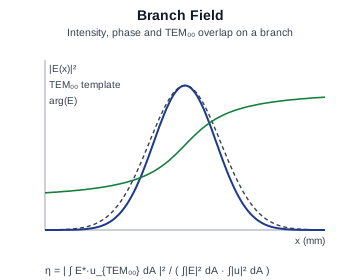
Worked example. A measured field \(E(x) = \exp(-x^{2}/w_{e}^{2})\) (Gaussian, waist \(w_{e}\)) is correlated against an ideal TEM₀₀ template \(u(x) = \exp(-x^{2}/w_{0}^{2})\) of waist \(w_{0}\).
For two identical Gaussians (\(w_{e} = w_{0} = w\)), \(\eta = 1\). If the template waist is mis-sized by 20% (\(w_{0} = 1.2\,w_{e}\)), the analytic 1-D overlap reduces to \(\eta = 4\,w_{e}^{2}\,w_{0}^{2}/(w_{e}^{2} + w_{0}^{2})^{2}\):
\(\eta = 4 \cdot 1 \cdot 1.44 / (1 + 1.44)^{2} = 5.76 / 5.9536 \approx 0.967\) — 3.3% coupling loss from waist mismatch alone.
For a 50% mismatch (\(w_{0} = 1.5\,w_{e}\)): \(\eta = 4 \cdot 2.25 / (1 + 2.25)^{2} = 9/10.5625 \approx 0.852\) — now a 15% coupling penalty.
KrakenOS code:
# Mode-overlap on sampled field arrays (E and u defined on the same grid)
def mode_overlap(E, u, dA):
    num   = np.abs(np.sum(np.conj(E) * u) * dA) ** 2
    den_E = np.sum(np.abs(E) ** 2) * dA
    den_u = np.sum(np.abs(u) ** 2) * dA
    return num / (den_E * den_u)

x_grid  = np.linspace(-3.0, 3.0, 2001)
dx      = x_grid[1] - x_grid[0]
we, w0  = 1.0, 1.2
E       = np.exp(-x_grid**2 / we**2)
u       = np.exp(-x_grid**2 / w0**2)
print(f"eta (Gaussian, w0/we=1.2) = {mode_overlap(E, u, dx):.4f}")

# In KrakenOS, a Gaussian-branch source's propagated field is exported
# from the branch field analysis (UI 'BField' button) -- pass the
# exported (x, E) array into `mode_overlap()` against your reference
# TEM00 template.
Diffr — Diffraction Detector
Computes the angular spectrum of the coherent field landing on the detector,
where
\((x, y)\) are detector-plane coordinates (mm),
\(E(x, y)\) is the complex scalar field on the detector (W^½ / mm),
\((k_{x}, k_{y})\) are the transverse wave-vector components (rad / mm),
\(\tilde{E}(k_{x}, k_{y})\) is the 2D spatial Fourier transform of \(E\), i.e. the angular spectrum.
The plot shows \(|\tilde{E}(k_{x}, k_{y})|^{2}\) versus angular direction
with \(k_{\lambda} = 2\pi/\lambda\) the vacuum wavenumber and \((\theta_{x}, \theta_{y})\) the corresponding propagation angles (radians). This is the natural output for gratings, holograms and far-field diffraction studies.
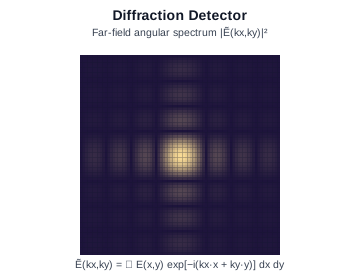
Worked example. Square aperture of side \(a = 1.0\) mm illuminated at \(\lambda = 0.5\) µm.
The 1-D angular spectrum of a top-hat of width \(a\) is \(\tilde{E}(k_{x}) \propto \mathrm{sinc}(k_{x} a / 2)\), so the first zero occurs at \(k_{x} a / 2 = \pi\), i.e. \(k_{x} = 2\pi/a = 2\pi/1.0\,\mathrm{mm} = 6.283\,\mathrm{rad/mm}\).
Converted to a propagation angle:
\(\theta_{x} = k_{x} / k_{\lambda} = 6.283 / (2\pi / 0.0005\,\mathrm{mm}) = 5.0 \cdot 10^{-4}\,\mathrm{rad} \approx 103\,\mathrm{arcsec}\).
In micrometres at a 1-m screen: \(500\) µm to the first dark fringe.
KrakenOS code:
# Compute the angular spectrum of a sampled field via 2D FFT.
def angular_spectrum(E, dx):
    Et = np.fft.fftshift(np.fft.fft2(np.fft.ifftshift(E))) * dx * dx
    N  = E.shape[0]
    kx = 2 * np.pi * np.fft.fftshift(np.fft.fftfreq(N, dx))
    return Et, kx

# Toy square aperture (replace E by the coherent field exported from
# KrakenOS' diffraction-detector analysis):
N, dx  = 512, 0.01                            # mm
x      = (np.arange(N) - N/2) * dx
E      = (np.abs(x)[:, None] < 0.5) & (np.abs(x)[None, :] < 0.5)
E      = E.astype(float)
Et, kx = angular_spectrum(E, dx)
theta  = kx / (2 * np.pi / (W * 1e-3))        # propagation angle, rad
peak   = np.argmax(np.abs(Et[N//2, :]))
# First zero index off-centre — find it
row    = np.abs(Et[N//2, :])
zero   = N//2 + 1 + np.argmin(row[N//2 + 1:])
print(f"first zero at theta = {theta[zero]*206265:.1f} arcsec")
Comparative analyses
Interf — Interferogram
Simulates a two-beam interference fringe pattern between the system wavefront and an ideal reference,
where
\((u, v)\) are normalised pupil coordinates,
\(I(u, v)\) is the fringe irradiance at the pupil sample point (W / mm²),
\(I_{1}\) is the test-beam irradiance (from the optical system under analysis),
\(I_{2}\) is the reference-beam irradiance (from the ideal reference arm),
\(2\sqrt{I_{1}\,I_{2}}\) is the fringe-visibility envelope for fully coherent interference (visibility \(V = 2\sqrt{I_{1}I_{2}} / (I_{1}+I_{2})\)),
\(\lambda\) is the wavelength (mm),
\(W(u, v)\) is the OPD wavefront of the test beam relative to the reference (mm),
\(\varphi_{0}\) is a global carrier-phase offset (radians), set by the alignment of the reference arm.
Adding tilt / defocus to \(W\) introduces straight or annular reference fringes the way a real Twyman–Green or Fizeau interferometer does.
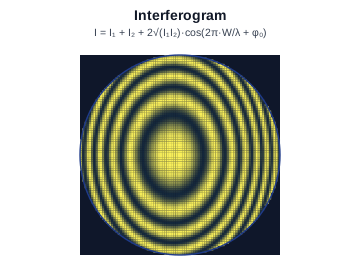
Worked example. Equal-intensity beams (\(I_{1} = I_{2} = 1\)), no carrier (\(\varphi_{0} = 0\)), wavelength \(\lambda = 0.5876\) µm. Tabulate \(I(u, v)\) at three representative wavefront-error samples:
\(W = 0\): \(I = 1 + 1 + 2\sqrt{1}\cos 0 = 4\) (bright fringe).
\(W = \lambda/4\): \(I = 1 + 1 + 2\cos(\pi/2) = 2\) (mid-fringe).
\(W = \lambda/2\): \(I = 1 + 1 + 2\cos(\pi) = 0\) (dark fringe).
Adding a 5-wave tilt to \(W\) (e.g. \(W = 5\lambda \cdot u\)) produces 10 straight fringes across the pupil diameter; tilt provides the spatial “carrier” used in real interferometer fringe-readout algorithms.
KrakenOS code:
X, Y, Z, _ = Kos.Phase2(Pup)                 # Z = W in waves
I1, I2 = 1.0, 1.0
phi0   = 0.0                                  # carrier-phase offset
tilt   = 5.0                                  # waves of tilt across the pupil
Z_test = Z + tilt * X / np.max(np.abs(X))

I = I1 + I2 + 2*np.sqrt(I1*I2) * np.cos(2*np.pi * Z_test + phi0)

import matplotlib.pyplot as plt
plt.scatter(X, Y, c=I, s=12, cmap="gray")
plt.axis("equal"); plt.colorbar(label="I (arb.)")
plt.title("Mock interferogram with 5-wave tilt carrier")
plt.show()
TolCmp — Tolerance Compare
Overlays the nominal-design spot diagram against the worst
Monte-Carlo sample from the tolerance run (see
KrakenOS/UI/validate_tolerance_monte_carlo.py). Each design parameter
is perturbed independently and the system is re-traced. The merit
function is
where
\(\boldsymbol{\delta} = (\delta p_{1}, \delta p_{2}, \ldots, \delta p_{K})\) is the vector of perturbations applied in one Monte-Carlo trial,
\(p_{k}\) is the \(k\)-th design parameter (e.g. surface radius, thickness, decentre, tilt, refractive index),
\(\delta p_{k}\) is a random draw from the tolerance distribution attached to \(p_{k}\) (typically uniform or Gaussian),
\(K\) is the total number of toleranced parameters,
\(\sigma_{\mathrm{RMS}}(\boldsymbol{\delta})\) is the RMS spot radius of the perturbed system at the test field (mm; lower is better),
\(\mathrm{Strehl}(\boldsymbol{\delta})\) is the on-axis Strehl ratio of the perturbed system (dimensionless; higher is better),
\(M(\boldsymbol{\delta})\) is the chosen merit function for the trial.
Many trials are run; the worst (highest \(\sigma_{\mathrm{RMS}}\) / lowest \(\mathrm{Strehl}\)) sample is shown overlaid on the nominal cluster.
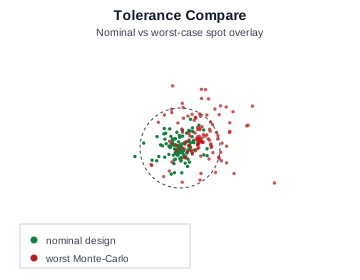
Worked example. Two toleranced parameters: surface-1 radius \(R_{1}\) with \(\delta R_{1} \sim U(-0.05, +0.05)\) mm, and element-2 axial thickness \(t_{2}\) with \(\delta t_{2} \sim N(0, 0.020)\) mm. Run \(K = 500\) Monte-Carlo trials. Suppose the empirical distribution of \(M = \sigma_{\mathrm{RMS}}\) is:
nominal: \(\sigma_{\mathrm{RMS}} = 5.0\) µm.
median Monte-Carlo: \(\sigma_{\mathrm{RMS}} = 8.4\) µm.
95th percentile: \(\sigma_{\mathrm{RMS}} = 16.9\) µm.
worst sample (max): \(\sigma_{\mathrm{RMS}} = 22.3\) µm.
The overlay plots the nominal cluster (tight, around the centroid) and the worst-sample cluster (offset and broadened) on the same axes; the ratio \(22.3 / 5.0 = 4.5\times\) is a quick sensitivity score.
KrakenOS code:
rng = np.random.default_rng(0)

def perturbed_sigma(seed_delta):
    # Apply perturbations in-place, retrace, restore.
    dR1, dt2 = seed_delta
    L1a.Rc       += dR1
    L1b.Thickness += dt2
    sys_p = Kos.system([P_Obj, L1a, L1b, L1c, Stop, P_Ima], Kos.Setup())
    Pup_p = Kos.PupilCalc(sys_p, Surf, W, "EPD", 10.0)
    Pup_p.Samp = Pup.Samp; Pup_p.Ptype = Pup.Ptype
    Pup_p.FieldType = Pup.FieldType
    Pup_p.FieldX, Pup_p.FieldY = Pup.FieldX, Pup.FieldY
    Rays = Kos.raykeeper(sys_p)
    x, y, z, L, M, N = Pup_p.Pattern2Field()
    for i in range(len(x)):
        sys_p.Trace([x[i], y[i], z[i]], [L[i], M[i], N[i]], W)
        Rays.push()
    X, Y, *_ = Rays.pick(-1)
    L1a.Rc       -= dR1
    L1b.Thickness -= dt2
    return np.sqrt(np.mean((X - X.mean())**2 + (Y - Y.mean())**2))

K = 200
results = []
for _ in range(K):
    dR1 = rng.uniform(-0.05, 0.05)
    dt2 = rng.normal(0.0, 0.020)
    results.append(perturbed_sigma((dR1, dt2)))

results = np.array(results) * 1e3            # mm -> um
print(f"nominal  sigma_RMS ~= 5 um   (trace once with no perturbations)")
print(f"MC median            = {np.median(results):.2f} um")
print(f"MC 95th percentile   = {np.percentile(results, 95):.2f} um")
print(f"MC max (worst)       = {results.max():.2f} um")
Cross-reference table
Button |
|
Anchor |
|---|---|---|
Spot |
|
|
RMS |
|
|
PSF |
|
|
MTF |
|
|
Pupil |
|
|
Seidel |
|
|
WFront |
|
|
Zernike |
|
|
FC/Dist |
|
|
Illum |
|
|
LatClr |
|
|
Pol |
|
|
Atmos |
|
|
PSFMap |
|
|
FldMap |
|
|
IllMap |
|
|
WfeMap |
|
|
DetMap |
|
|
CohDet |
|
|
BField |
|
|
Diffr |
|
|
Interf |
|
|
TolCmp |
|