Finding the Cardinal Points and Pupils by Ray Tracing
This page is a textbook-style walk-through of how to locate every first-order landmark of a centred optical system using construction rays only: the front and rear focal points \(F, F'\), the principal planes \(P, P'\), the nodal points \(N, N'\), and the entrance and exit pupils EP and XP.
Each figure carries numbered Step 1, Step 2, … badges next to
the rays that produce each landmark — read them in order.
Drawing conventions
Light propagates left → right along the optical axis (dashed grey).
The whole optical system is drawn as a translucent rectangular block (or, in Figures 5–6, as a pair of thin lenses \(L_{1}, L_{2}\) so the aperture stop is visible between them).
Solid coloured lines are real ray segments.
Grey-dashed lines are virtual / construction extensions.
Coloured vertical dashes mark principal planes; small filled dots mark focal and nodal points.
KrakenOS exposes all of these landmarks at runtime through
KrakenOS.PupilCalc (Pup.PosPupInp, Pup.PosPupOut,
Pup.PPP, Pup.PPA, Pup.EFFL; see PupilCalc Tool and
KrakenOS/PupilTool.py), but the constructions below explain why
those numbers are what they are.
1. The six cardinal points
Any centred imaging system can be replaced — at first order — by six axial points: two focal points \(F, F'\), two principal planes \(P, P'\), and two nodal points \(N, N'\). In air (same medium on both sides) the nodal points coincide with the principal points (\(N \equiv P\), \(N' \equiv P'\)), so it is common to see only four labels on a diagram.
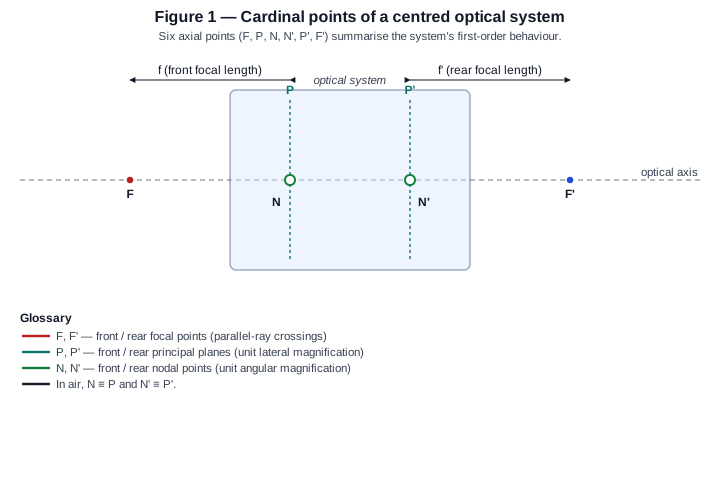
The four / six axial landmarks. The effective focal lengths \(f\) and \(f'\) are measured from the principal plane to the corresponding focal point.
The thin-lens equation, the Newtonian imaging equation, and the Gaussian magnification formulas are all written in terms of these landmarks:
where \(s, s'\) are object/image distances measured from \(P, P'\), and \(x, x'\) are the Newtonian distances measured from \(F, F'\).
2. Locating \(F'\) and \(P'\)
The classical recipe: send in a ray that is parallel to the optical axis, then look at what comes out. The exit point on the axis is the rear focal point \(F'\); the height at which the construction extensions cross is the rear principal plane \(P'\).
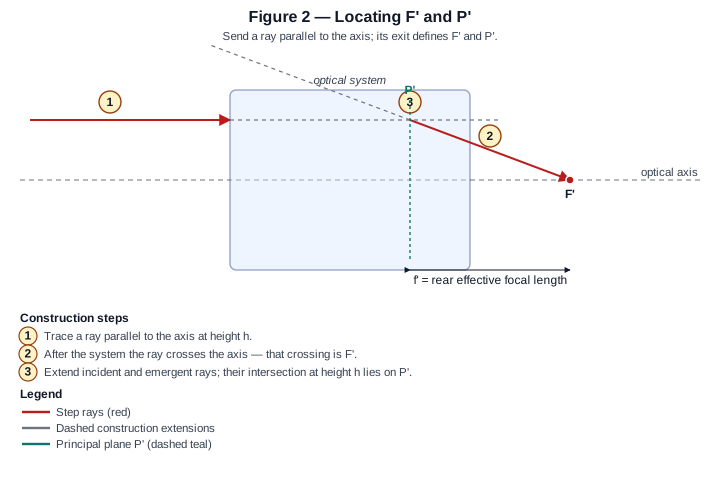
Step 1. Trace a ray parallel to the axis at height \(h\). Step 2. The ray emerges and crosses the axis — that crossing is \(F'\). Step 3. Extend the incident ray forward (dashed) and the emergent ray backward (dashed); the height at which they meet, \(h\), lies on the rear principal plane \(P'\).
The distance from \(P'\) to \(F'\) is the rear effective focal length \(f' = \overline{P' F'}\). For a system in air \(f = f'\).
In code, KrakenOS’s paraxial backend reports \(f'\) as
Pup.EFFL (see PupilCalc.__init__ calling SYSTEM.Parax).
3. Locating \(F\) and \(P\)
Mirror construction: send a ray out of the system parallel to the axis and ask where it must have come from. By the time-reversal symmetry of geometric optics, any such ray must have entered at the front focal point \(F\).
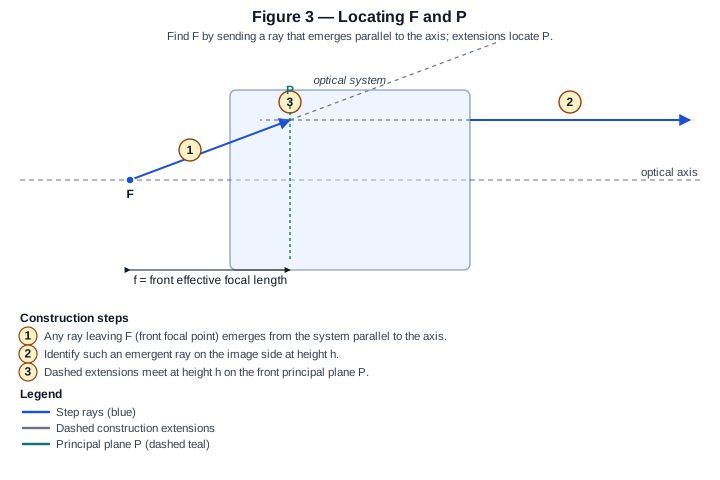
Step 1. Any ray leaving \(F\) emerges parallel to the axis. Step 2. Identify such an emergent ray at height \(h\). Step 3. Extend the incident ray forward to where the emergent ray comes from; the intersection at height \(h\) lies on the front principal plane \(P\).
The front effective focal length is \(f = \overline{F P}\),
returned in KrakenOS as Pup.PPP together with Pup.PPA (the two
principal-plane axial positions).
4. Nodal points \(N, N'\)
The angular analogue of the principal points. They satisfy:
A ray aimed at \(N\) emerges from \(N'\) parallel to itself.
In symbols, the angular magnification between \(N\) and \(N'\) is \(+1\). In air the nodal points coincide with the principal points; they only separate when the object- and image-space refractive indices differ (e.g. an object in air, image in water).
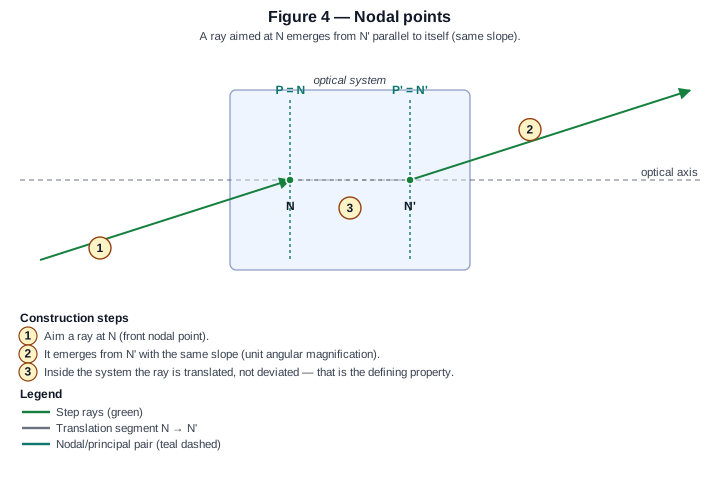
Step 1. Aim a ray at \(N\). Step 2. It emerges from \(N'\) with the same slope. Step 3. Inside the system the ray is translated but not deviated — that is the defining property of the nodal pair.
Mathematically, with \(n\) and \(n'\) the indices of object and image space,
In air, \(n = n' = 1\), so \(\overline{P N} = 0\) and \(N \equiv P\), \(N' \equiv P'\).
5. Aperture stop, EP and XP
The aperture stop is the surface that physically limits the on-axis ray bundle. The entrance pupil EP and exit pupil XP are the images of that stop formed by the optics in front of the stop and behind the stop, respectively.
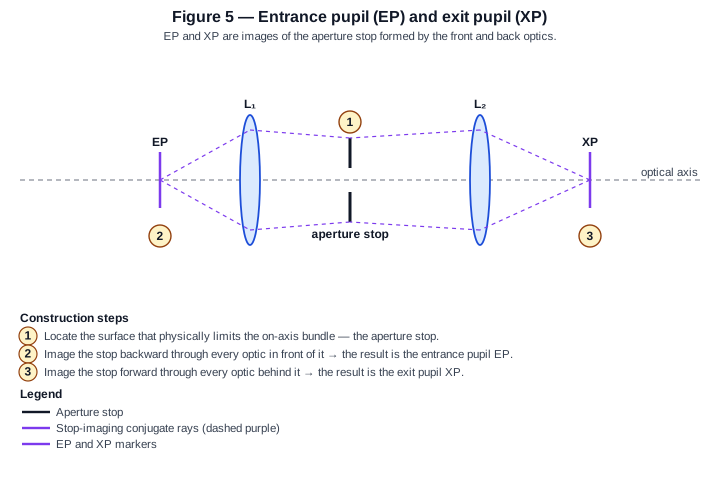
Step 1. Identify the aperture stop (the bar with a hole here, between \(L_{1}\) and \(L_{2}\)). Step 2. Image the stop backward through every surface in front of it — the resulting image is the entrance pupil EP. Step 3. Image the stop forward through every surface behind it — the resulting image is the exit pupil XP. Both are conjugates of the stop, so a ray that hits the centre of the stop must also pass through the centres of EP and XP.
The pupil magnifications
introduced in PupilCalc Tool, are exactly the lateral
magnifications of the front-side and back-side stop-imaging steps
above. KrakenOS computes them numerically by tracing the same fan of
rays shown in PupilCalc.__init__ and reading Pup.RadPupInp,
Pup.PosPupInp, Pup.RadPupOut, Pup.PosPupOut.
6. Chief and marginal rays — the operational definition
In practice you almost never image the stop by hand. Instead, you identify EP and XP as the axis-crossings of the chief ray:
the marginal ray is launched from the on-axis foot of the object and just grazes the edge of the stop;
the chief ray is launched from the edge of the field and passes through the centre of the stop.
Because the chief ray must hit the centre of the stop, it must — by conjugacy — also hit the centres of EP (on the object side) and XP (on the image side). Extend it both ways and read off the axis-crossings.
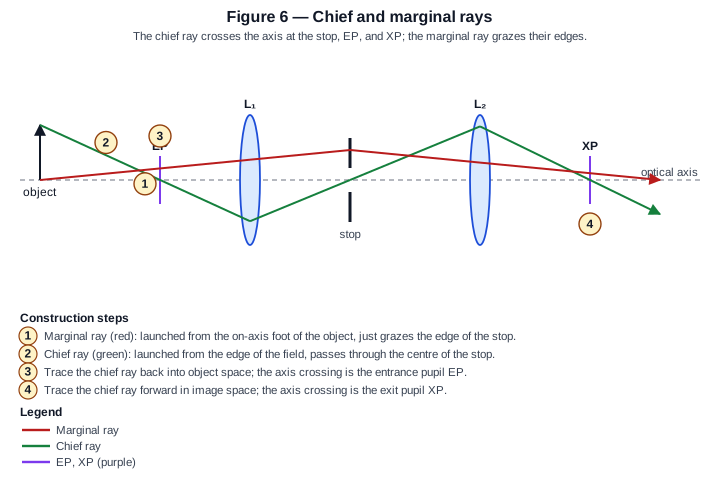
Step 1. Trace the marginal ray (red): on-axis object foot → edge of stop → image-side focus. Step 2. Trace the chief ray (green): top of object → centre of stop → image. Step 3. Extend the chief ray backward into object space; the axis crossing is the entrance pupil EP. Step 4. Extend the chief ray forward in image space; the axis crossing is the exit pupil XP.
The marginal ray simultaneously determines the system F-number,
with \(\theta_{\mathrm{marg}}\) the marginal-ray slope in image space and \(D_{\mathrm{EP}}\) the entrance-pupil diameter.
7. Putting it all together
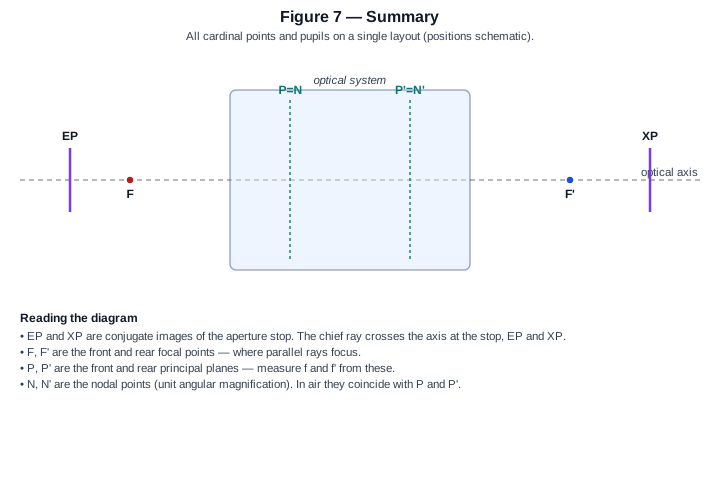
The complete first-order summary: EP — F — P/N — system — P’/N’ — F’ — XP. EP and XP are conjugates of the aperture stop; the chief ray passes through the axis at all three; \(f, f'\) are measured from the principal planes.
KrakenOS surface roles (in the KrakenOS Layout Editor) map onto this picture as follows:
The analysis surface chosen via the Layout Editor’s “Analysis surface” combobox is the surface used as the aperture stop when
Aperture type = STOP(or whose image gives EP/XP whenAperture type = EPD).Toggling Show PP / EP / XP in the editor toolbar overlays \(P', \mathrm{EP}, \mathrm{XP}\) markers in the 2D layout plot.
Pup.PosPupInpandPup.PosPupOutare the axial coordinates of EP and XP returned byPupilCalc;Pup.PPA,Pup.PPPhold the principal-plane positions;Pup.EFFLis \(f'\).
See PupilCalc Tool for the numerical extraction, and Pupil Patterns (Source Model: Pupil / field) for how a chosen EP / chief-ray axis is then populated with sample rays.