Photonics Essentials: Chapter 8 Problems
Source
Thomas P. Pearsall, Photonics Essentials: An Introduction with Experiments
(McGraw-Hill, 2003), Chapter 8, Direct Modulation of Laser Diodes,
Problems 8.1–8.3, printed page 190.
The book labels both of its final two exercises 8.2. This page calls the
last one 8.3.
Worked solutions
Problem 8.1: Band filling and wavelength chirp
Brief solution
1. Method.
Let a current pulse be shorter than the recombination time.
2. Key step.
3. Answer.
Show detailed steps
Let a current pulse be shorter than the recombination time.
Before the pulse
During carrier injection
Carriers enter faster than they recombine. States nearest the band edges fill first; Pauli exclusion forces later electrons to higher conduction-band states and holes deeper into the valence band:
After stimulated recombination begins
The highest-energy occupied states recombine and empty first. The carrier distribution retreats toward the band edges:
Since \(\lambda=hc/E_\gamma\), decreasing photon energy means increasing wavelength:
Problem 8.2: Delay with 90% threshold prebias
Brief solution
1. Method.
Equation 8.8 gives
2. Key step.
3. Answer.
Show detailed steps
Equation 8.8 gives
where \(J_2>J_{\mathrm{th}}>J_1\). Put \(\tau_r=10^{-10}\ \mathrm s=100\ \mathrm{ps}\) and \(J_1=0.9J_{\mathrm{th}}\):
\(J_2/J_{\mathrm{th}}\) |
1.1 |
5 |
10 |
20 |
|---|---|---|---|---|
\(\tau_d\) (ps) |
69.3 |
2.47 |
1.10 |
0.525 |
For example,
Problem 8.3: Other prebias levels
Brief solution
1. Method.
Repeat the same calculation:
2. Key step.
3. Answer.
A negligible delay is obtained by prebiasing close to threshold and driving several times above threshold. Neither variable should be taken to an extreme: high prebias increases off-state light and power, while a large current step increases heating, relaxation oscillations, and wavelength chirp. A practical choice is therefore the smallest \(J_1\) and \(J_2\) that meet the system’s delay, extinction-ratio, thermal, and spectral requirements.
Show detailed steps
Repeat the same calculation:
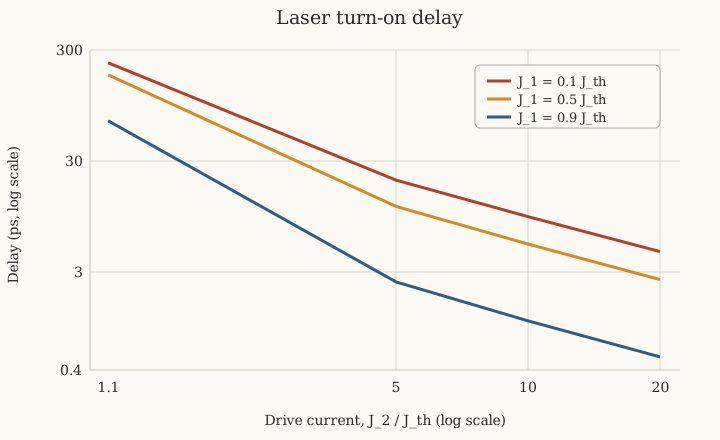
Design curves from Equation 8.8. Both axes are logarithmic.
\(J_1/J_{\mathrm{th}}\) |
\(1.1J_{\mathrm{th}}\) |
\(5J_{\mathrm{th}}\) |
\(10J_{\mathrm{th}}\) |
\(20J_{\mathrm{th}}\) |
|---|---|---|---|---|
0.1 |
230 ps |
20.3 ps |
9.53 ps |
4.63 ps |
0.5 |
179 ps |
11.8 ps |
5.41 ps |
2.60 ps |
0.9 |
69.3 ps |
2.47 ps |
1.10 ps |
0.525 ps |
The design trends are clear:
A negligible delay is obtained by prebiasing close to threshold and driving several times above threshold. Neither variable should be taken to an extreme: high prebias increases off-state light and power, while a large current step increases heating, relaxation oscillations, and wavelength chirp. A practical choice is therefore the smallest \(J_1\) and \(J_2\) that meet the system’s delay, extinction-ratio, thermal, and spectral requirements.