Chapter 11: Light Emission in Semiconductors
Source: Hunsperger, sixth edition (2009), Problems 11.1–11.10, printed pages 238–239.
Problem 11.1 — Linewidth, inversion, and divergence
Working. An LED emits spontaneously across a distribution of occupied electron and hole energies; it has no strong cavity selection. A laser preferentially amplifies resonant modes, narrowing the spectrum. Laser operation needs population inversion at the photon energy and modal gain sufficient to overcome the complete cavity loss.
The small laser aperture still diffracts: roughly \(\theta_{\rm div}\sim\lambda_0/w\). Its uncollimated far field can span tens of degrees, with different divergences along the thin and wide axes. A lens increases beam diameter and reduces divergence.
Answer. Spectral selection and stimulated emission produce narrow laser lines, but do not eliminate diffraction from a micrometre aperture.
Check. The textbook linewidths are representative, not universal limits. A single laser can have multiple narrow longitudinal lines.
Problem 11.2 — Einstein absorption and stimulated-emission coefficients
Working. Divide the supplied equilibrium balance by photon density:
As \(\rho\to\infty\), this establishes \(B_{12}N_1=B_{21}N_2\). For a nondegenerate two-level system in the high-temperature equilibrium limit, \(N_1/N_2\to1\), giving \(B_{12}=B_{21}\).
Answer. The requested equality follows with the implicit equal-degeneracy, equal-limiting-population assumption. More generally \(g_1B_{12}=g_2B_{21}\).
Check. The supplied balance equation and large photon density alone do not prove equal coefficients for arbitrary populations. The population/degeneracy assumption must be made explicit.
Problem 11.3 — Photon wavelength from momentum conservation
Working. For the collinear direct transition, \(k_\gamma=k_f-k_i=10^5\,{\rm cm}^{-1}\). Wavevector magnitude is \(2\pi/\lambda\), so
Answer. The photon wavelength in the material is 0.6283 micrometres. Its vacuum wavelength is \(n(\omega)\) times this value.
Check. No refractive index is supplied, so a unique vacuum wavelength does not follow. Replacing \(2\pi/k\) by \(1/k\) confuses angular wavevector and spectroscopic wavenumber.
Problem 11.4 — Efficiency of a laser relative to an LED
Working. Above threshold, stimulated recombination directs a large fraction of incremental injected carriers into selected optical modes. An LED distributes spontaneous emission across many directions and frequencies, and useful extraction can be limited by total internal reflection and packaging.
Answer. A laser can convert incremental current efficiently into a useful directed coherent beam.
Check. This is not a universal statement about total wall-plug efficiency. The laser pays a threshold-current overhead, and a well-designed LED can be more efficient at low required output.
Problem 11.5 — Spectra below, at, and above threshold
Working. Below threshold draw a broad spontaneous-emission envelope. Near threshold, cavity resonances emerge on that envelope. Above threshold, draw narrow, stronger resonant lines and a relatively weak spontaneous background.
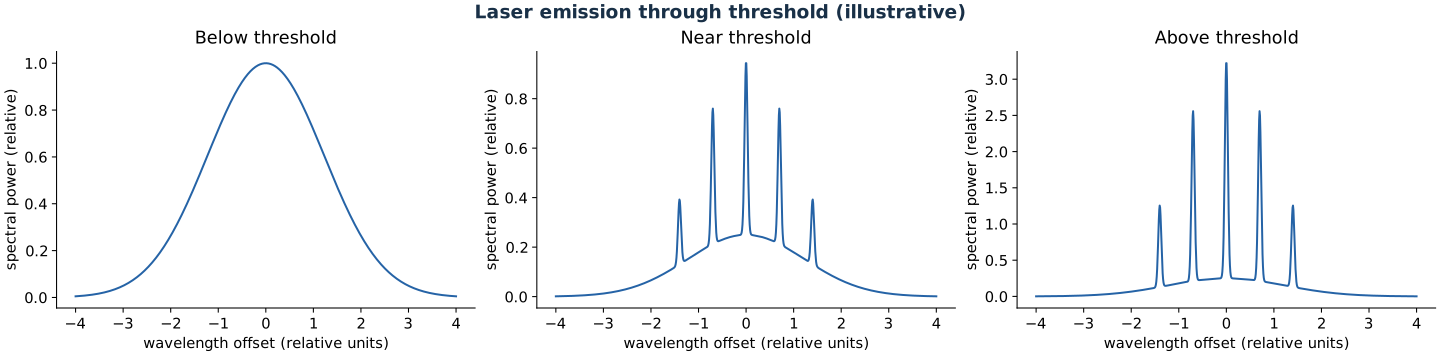
Illustrative spectra; widths and amplitudes are not measurement data.
Answer. The change is both spectral narrowing and redistribution of power into oscillating modes.
Check. A Fabry–Perot laser above threshold need not be single-longitudinal-mode. Do not replace every above-threshold spectrum by one line automatically.
Problem 11.6 — Quasi-Fermi levels and the gain band
Working. Forward injection creates separate electron and hole quasi-Fermi levels, \(E_{Fn}\) and \(E_{Fp}\). For net interband stimulated emission at photon energy \(h\nu\), the idealized inversion criterion is
Draw the conduction and valence edges, reduced junction barrier, and separate quasi-Fermi levels in the injected active region.
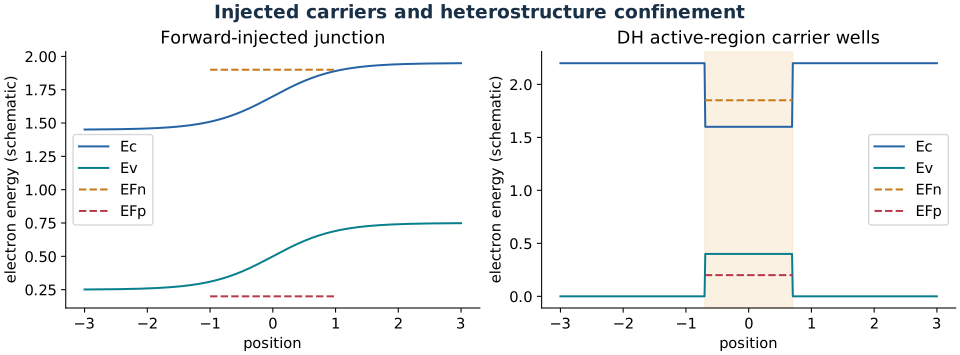
Schematic electron-energy profiles.
Answer. The longest-wavelength ideal gain edge corresponds to \(E_g\); the shortest corresponds to quasi-Fermi separation.
Check. Finite temperature, band filling, loss, and cavity resonances modify the actual lasing spectrum. The inequality is a gain window, not a prediction that every frequency in it oscillates.
Problem 11.7 — High optical power density in semiconductors
Working. A solid contains a very high density of available electronic states compared with a dilute gas. Injection concentrates carriers in a small active region, and direct transitions can supply large gain over a short distance. Optical and carrier confinement further shrink the useful active volume.
Answer. High carrier density and strong confined gain permit large generated power per active volume.
Check. Power density is limited by heat extraction, gain saturation, and damage. A small volume does not imply an unlimited total output power.
Problem 11.8 — Why the Fermi levels are only quasi-Fermi levels
Working. Pumping maintains a nonequilibrium electron-hole population. Fast intraband scattering can approximately thermalize each carrier population separately, allowing one Fermi–Dirac distribution for electrons and another for holes. Interband recombination has not returned them to a common chemical potential.
Answer. Two quasi-Fermi levels describe internally equilibrated subsystems that are not in mutual equilibrium.
Check. At thermal equilibrium the two levels coincide. A single equilibrium Fermi level cannot describe sustained population inversion.
Problem 11.9 — Compare laser-diode and LED light
Working. An LED produces predominantly spontaneous emission with broad spectral and angular distributions and low mutual coherence between emission events. A laser has feedback-selected stimulated emission, giving narrow lines, stronger coherence, and a useful directional output. Its finite aperture still produces an asymmetric, divergent beam.
Answer. Compare spectrum, coherence, directionality, and threshold behavior; these distinguish the mechanisms more clearly than brightness alone.
Check. Neither perfect collimation nor perfect monochromaticity is a necessary laser property. Both devices require suitable collection optics for a specified application.
Problem 11.10 — Photon energy including carrier excess energies
Working. The electron is 20 meV above the conduction edge; the final valence state is 35 meV below its edge. Therefore
Answer. With a stated room-temperature GaAs approximation \(E_g=1.43\) eV, \(\lambda_0\simeq0.83491\,\mu{\rm m}\).
Check. Both excess energies add. Temperature is not given in the problem; using 1.42 eV instead produces 0.84057 micrometres. The symbolic expression exposes that material-data dependence.