Photonics Essentials: Chapter 2 Problems
Source
Thomas P. Pearsall, Photonics Essentials: An Introduction with Experiments
(McGraw-Hill, 2003), Chapter 2, Electrons and Photons, Problems 2.1–2.8,
printed pages 32–34.
The problems are paraphrased below. Calculations use \(T=295\ \mathrm K\), \(k_B T=0.026\ \mathrm{eV}\), and
Quick results
Problem |
Result |
|---|---|
2.1 |
Conduction-band separation: \(0.838\ \mathrm{eV}\) |
2.2 |
Phonon: \(\lambda\approx1.25\ \mathrm{nm}\), \(f\approx6.83\ \mathrm{THz}\), \(E\approx28.2\ \mathrm{meV}\) |
2.3 |
Electron wavelength: \(29.8\ \mathrm{nm}\), about 53 conventional cells and \(6.2\times10^5\) atoms |
2.4 |
Correct relation: \(E(\mathrm{eV})=1239.84/\lambda(\mathrm{nm})\) |
2.5 |
The 200–2000 nm interval corresponds to 6.20–0.620 eV |
2.6 |
Free-particle equation: \(-\hbar^2\psi''/(2m)=E\psi\) |
2.7 |
Ideally, reflection and transmission; no band-to-band absorption |
2.8 |
Frequency is unchanged; wavelength and speed both fall by \(1/n\) |
Worked solutions
Problem 2.1: Energy step across a p-n junction
Brief solution
1. Method.
Paraphrase. At equilibrium, the electron densities on the two sides are \(n_n=10^{18}\ \mathrm{cm^{-3}}\) and \(n_p=10^4\ \mathrm{cm^{-3}}\). Find the conduction-band energy difference at room temperature.
2. Key step.
3. Answer.
The side with fewer conduction electrons has the higher conduction-band edge. As a check, inserting \(0.838\ \mathrm{eV}\) into Equation (1) returns the required density ratio \(10^{-14}\).
Show detailed steps
Paraphrase. At equilibrium, the electron densities on the two sides are \(n_n=10^{18}\ \mathrm{cm^{-3}}\) and \(n_p=10^4\ \mathrm{cm^{-3}}\). Find the conduction-band energy difference at room temperature.
For two electron populations in thermal equilibrium, the Boltzmann relation is
Take the natural logarithm and solve for \(\Delta E_C\):
The side with fewer conduction electrons has the higher conduction-band edge. As a check, inserting \(0.838\ \mathrm{eV}\) into Equation (1) returns the required density ratio \(10^{-14}\).
Problem 2.2: Photon-electron-phonon collision
Brief solution
2. Answer.
Paraphrase. A \(1\ \mathrm{eV}\) photon transfers energy to an electron initially at rest. A silicon phonon supplies the momentum balance. Find the phonon wavelength, frequency, and energy; then find the electron energy and discuss the room-temperature initial state.
Show detailed steps
Paraphrase. A \(1\ \mathrm{eV}\) photon transfers energy to an electron initially at rest. A silicon phonon supplies the momentum balance. Find the phonon wavelength, frequency, and energy; then find the electron energy and discuss the room-temperature initial state.
Assumptions and conservation laws
The problem does not specify an electron effective mass, so we use the free electron mass \(m_e=9.109\times10^{-31}\ \mathrm{kg}\), consistent with the chapter’s preceding \(1\ \mathrm{eV}\) electron estimate. The photon momentum,
is only about one thousandth of the final electron momentum.
At \(T=0\), no thermal phonon is available for absorption, so the physical branch is phonon emission. Neglecting the very small \(p_\gamma\) in the first estimate, momentum and energy conservation give
where \(v_s=8.5\times10^3\ \mathrm{m/s}\) and \(E_{\mathrm{ph}}=v_s p\).
Solve the quadratic
using the positive root:
Phonon properties
The phonon de Broglie wavelength is
Its frequency and energy are
Thus,
Final and room-temperature electron energies
For the phonon-emission branch, Equation (2) gives
If a phonon is already present and is absorbed instead, the corresponding solution is approximately \(E_{e,f}=1.029\ \mathrm{eV}\). Stating the phonon branch is therefore essential.
At room temperature the characteristic initial thermal energy is
The three-dimensional mean translational energy is \(3k_BT/2\approx0.039\ \mathrm{eV}\). The exact initial energy and momentum are thermally distributed, so a room-temperature collision does not have one unique initial value.
Problem 2.3: Thermal electron wavelength in GaAs
Brief solution
2. Answer.
Paraphrase. Use the GaAs electron effective mass \(m^*=0.065m_e\) and thermal kinetic energy \(k_BT\) to find its de Broglie wavelength, express that length in crystal cells, and estimate how many atoms occupy a sphere of that diameter.
Show detailed steps
Paraphrase. Use the GaAs electron effective mass \(m^*=0.065m_e\) and thermal kinetic energy \(k_BT\) to find its de Broglie wavelength, express that length in crystal cells, and estimate how many atoms occupy a sphere of that diameter.
Electron wavelength
For a nonrelativistic electron,
so
Therefore,
Crystal cells along the wavelength
The problem does not provide a lattice constant. Using the standard room-temperature GaAs conventional-cell dimension \(a=0.565\ \mathrm{nm}\),
The wavelength spans approximately
Atoms in a wavelength-diameter sphere
The conventional zinc-blende GaAs cell contains four Ga atoms and four As atoms, or eight atoms total. The atomic number density in this cell model is \(8/a^3\). A sphere of diameter \(\lambda\) has volume \(\pi\lambda^3/6\), hence
This large number illustrates what it means for a conduction electron to be delocalized over the crystal.
Problem 2.4: Photon energy from wavelength
Brief solution
1. Method.
Paraphrase. Derive the electron-volt photon-energy formula from \(E=hf\) and \(c=f\lambda\).
2. Key step.
3. Answer.
Show detailed steps
Paraphrase. Derive the electron-volt photon-energy formula from \(E=hf\) and \(c=f\lambda\).
Eliminate frequency:
For wavelength in nanometres, write \(\lambda=\lambda_{\mathrm{nm}}10^{-9}\ \mathrm m\), then convert joules to electron volts:
Thus the convenient rounded relation is
Important
Typographical error in the problem
The formula printed in Problem 2.4 has \(124\) in the numerator. It is missing a zero. The chapter’s own earlier result that a \(1\ \mathrm{eV}\) photon has wavelength \(1240\ \mathrm{nm}\) confirms the correct constant.
Problem 2.5: Energy-wavelength conversion chart
Brief solution
1. Method.
Paraphrase. Construct aligned wavelength and photon-energy axes from \(200\) to \(2000\ \mathrm{nm}\); mark blue, green, red, and the \(1550\ \mathrm{nm}\) telecommunications region.
2. Key step.
3. Answer.
The chart uses approximate colour intervals of 450–495 nm for blue, 495–570 nm for green, and 620–700 nm for red. At the fibre telecommunications wavelength,
Show detailed steps
Paraphrase. Construct aligned wavelength and photon-energy axes from \(200\) to \(2000\ \mathrm{nm}\); mark blue, green, red, and the \(1550\ \mathrm{nm}\) telecommunications region.
Use Equation (3) at the two endpoints:
The requested corresponding energy interval is therefore
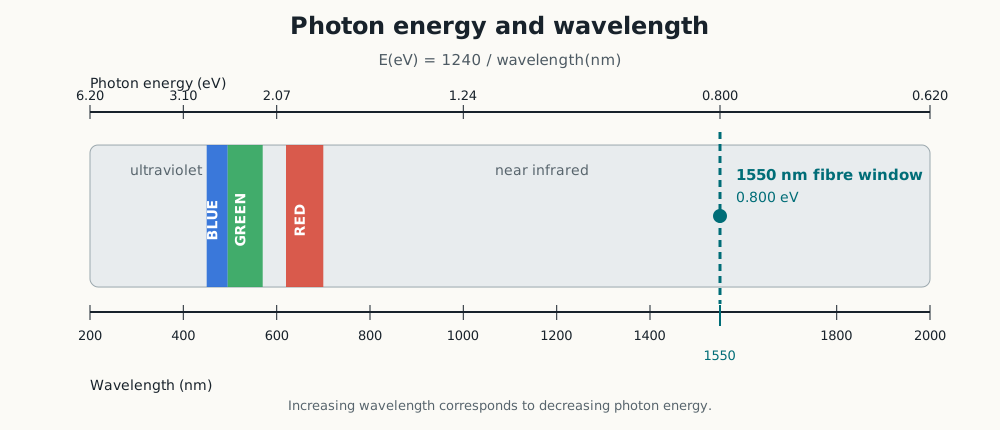
A wavelength-linear conversion chart. The upper energy labels are nonlinear because \(E\) is proportional to \(1/\lambda\). Colour boundaries are approximate and vary slightly among references.
The chart uses approximate colour intervals of 450–495 nm for blue, 495–570 nm for green, and 620–700 nm for red. At the fibre telecommunications wavelength,
Blue photons have more energy than red photons because blue has the shorter wavelength.
Problem 2.6: From a sinusoidal wave to electron energy
Brief solution
1. Method.
Part a: differentiate the wave. Start with
2. Key step.
3. Answer.
Equation (4) is the one-dimensional, time-independent Schrödinger equation for a free particle. A potential \(V(x)\) adds a term \(V(x)\psi(x)\) on the left.
Show detailed steps
Part a: differentiate the wave. Start with
The two derivatives are
Part b: introduce momentum and energy. Since \(k=2\pi/\lambda\) and \(\hbar=h/(2\pi)\), de Broglie’s relation gives
The nonrelativistic kinetic energy is therefore
Multiply the second-derivative equation by \(-\hbar^2/(2m)\):
Thus,
Equation (4) is the one-dimensional, time-independent Schrödinger equation for a free particle. A potential \(V(x)\) adds a term \(V(x)\psi(x)\) on the left.
Problem 2.7: Sub-bandgap light incident on silicon
Brief solution
1. Method.
Paraphrase. Decide whether \(1240\ \mathrm{nm}\) light is absorbed, reflected, or transmitted by a \(0.5\ \mathrm{mm}\) silicon wafer whose band gap is \(1.1\ \mathrm{eV}\).
2. Key step.
3. Answer.
Real wafers can have weak free-carrier, defect, surface, or multiphoton absorption. Those mechanisms are outside the three-process idealization in the problem.
Show detailed steps
Paraphrase. Decide whether \(1240\ \mathrm{nm}\) light is absorbed, reflected, or transmitted by a \(0.5\ \mathrm{mm}\) silicon wafer whose band gap is \(1.1\ \mathrm{eV}\).
The photon energy is
Since
one photon cannot promote a valence electron across the band gap. In the ideal model there is therefore no band-to-band absorption. The air-silicon index discontinuity still reflects part of the beam, and the remainder is transmitted through the wafer:
Real wafers can have weak free-carrier, defect, surface, or multiphoton absorption. Those mechanisms are outside the three-process idealization in the problem.
Problem 2.8: What changes when light enters glass?
Brief solution
1. Method.
Paraphrase. Light crosses from air into glass of refractive index \(n=1.5\). Determine whether its frequency, wavelength, or both change, and justify the result using photon energy.
2. Key step.
3. Answer.
Show detailed steps
Paraphrase. Light crosses from air into glass of refractive index \(n=1.5\). Determine whether its frequency, wavelength, or both change, and justify the result using photon energy.
A stationary boundary cannot create a new time oscillation rate. Equivalently, the photon energy is conserved across a passive interface:
so
The speed in glass is
Because \(v=f\lambda\) and the frequency is unchanged,
Therefore the speed and wavelength both decrease by the factor \(1/n\), while frequency and photon energy remain unchanged: