Chapter 7: Waveguide Input and Output Couplers
Source: Hunsperger, sixth edition (2009), Problems 7.1–7.12, printed pages 149–151.
Angle convention for prism calculations
Let \(\gamma\) be the exit face angle to the guide plane and \(\psi\) the outgoing beam’s angle above that plane. The face normal lies at \(\nu=90^\circ-\gamma\). On the geometry branch used below, Snell’s law and phase matching give
Reverse the rays for input coupling. Angles from a face normal are signed; their sign identifies which side of the normal contains the ray.
Problem 7.1 — Effective indices from three prism lines
Working. Use \(\gamma=60^\circ\), so \(\nu=30^\circ\), with \(n_p=2.32\) and \(\lambda_0=0.905\,\mu{\rm m}\). For each measured beam angle apply (1).
\(\psi\) |
\(N\) |
\(\beta\ [{\rm cm}^{-1}]\) |
|---|---|---|
36.5 degrees |
1.95018 |
135396 |
30.2 degrees |
2.00743 |
139371 |
24.6 degrees |
2.05458 |
142644 |
Answer. The smallest listed exit angle belongs to the lowest order because it gives the largest effective index.
Check. All effective indices remain below the core index 2.09. The external surface angle is not the internal incidence angle.
Problem 7.2 — Excite the same fundamental through rutile
Working. Keep \(N_0=2.05458\) from 7.1 and replace the prism index by 2.50. The internal ray angle from the guide plane is \(\chi=\cos^{-1}(N_0/2.50)\). Subtract the face-normal angle 30 degrees, refract to air, and restore that normal angle:
Answer. Use the reciprocal input ray making about 41.90 degrees with the guide surface.
Check. The 11.90 degree result inside the last arcsine is the angle relative to the entrance-face normal, not the requested surface angle.
Problem 7.3 — Derive longitudinal phase matching
Working. A plane wave inside the prism has magnitude \(k_0n_p\). If its incidence angle from the guide normal is \(\theta_p\), its tangential component is \(k_0n_p\sin\theta_p\). Coupling contributions at different points along the guide accumulate constructively only when this component equals the guided propagation constant.
Answer. This is the required prism phase-matching condition.
Check. Phase matching alone is insufficient: the evanescent fields must overlap across a sufficiently thin gap and the interaction length must supply appreciable transfer.
Problem 7.4 — Input angle for the right-angle prism
Working. Convert \(\beta=1.40\times10^5\,{\rm cm}^{-1}\) to \(N=\beta(0.905\times10^{-4})/(2\pi)=2.01654\). For \(n_p=2.32\), the internal ray makes \(\chi=\cos^{-1}(N/n_p)\) with the guide. With a 45 degree face, its internal signed incidence is \(\chi-45^\circ\). Snell refraction gives
Answer. The input beam makes about 7.07 degrees with the surface on this reciprocal-ray branch.
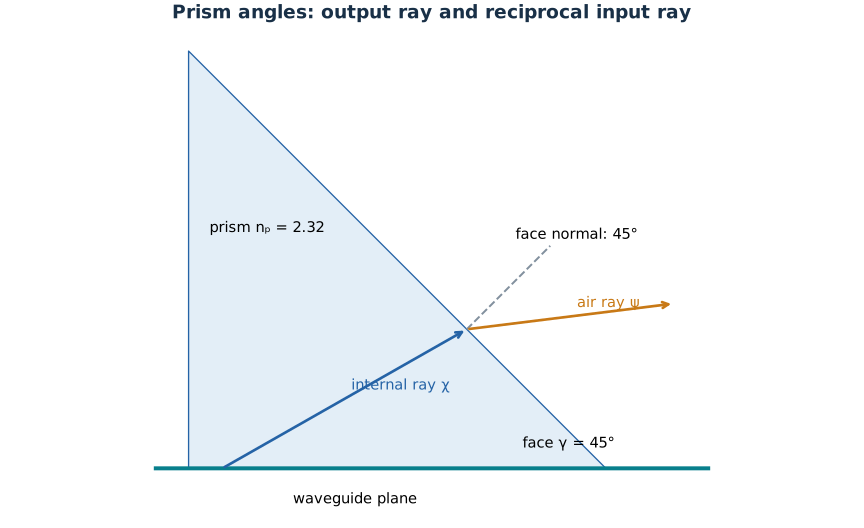
Reverse the arrows for reciprocal input coupling.
Check. Label \(\chi\), the face normal, and \(\psi\) separately. A 45 degree face does not imply 45 degree beam incidence.
Problem 7.5 — Smallest period for backward reflection
Working. Reversing a guided wave changes its axial momentum from \(+\beta\) to \(-\beta\). A first-order grating supplies \(K=2\pi/\Lambda=2\beta\). Therefore
Answer. A first-order 200 nm grating.
Check. Higher diffraction orders have larger periods for the same backward-scattering momentum, so they do not give a smaller spacing.
Problem 7.6 — Choose a prism face for direct entrance
Working. The given propagation constant implies \(N=(1.44\times10^5)(0.905\times10^{-4})/(2\pi)\). Phase matching in the \(n_p=2.5\) prism gives an internal ray angle \(\phi=33.9379^\circ\) from the guide plane. Choose normal incidence on the entrance face, making its normal parallel to the ray.
Answer. A convenient face angle is \(\gamma=90^\circ-\phi=56.0621^\circ\); the internal ray makes 33.9379 degrees with the guide.
Check. This is the natural normal-entrance geometry, not a complete optimization of coupling efficiency. Gap, beam width, polarization, Fresnel transmission, and interaction length also matter.
Problem 7.7 — First-order grating input angle
Working. For incidence from air at angle \(\psi\) from the surface, tangential momentum conservation is \(N=\cos\psi+\lambda_0/\Lambda\). Hence
Answer. Approximately 43.53 degrees from the surface.
Check. The required cosine lies between minus one and one. Without grating momentum, an air beam cannot supply an effective index of 3.6.
Problem 7.8 — Exit beam from a 45-degree prism
Working. From \(N=1.481\) and \(n_p=2.25\), the internal ray angle is \(\chi=\cos^{-1}(1.481/2.25)\). Refract its signed angle \(\chi-45^\circ\) at the exit:
Answer. The emerging beam makes about 53.66 degrees with the waveguide surface on the illustrated exit branch.
Check. The air-side angle relative to the prism normal is only 8.6565 degrees; it is not the surface angle.
Problem 7.9 — Use the face angle in the supplied drawing
Data. The drawing shows a 30 degree face, index 2.2, and an outgoing ray 26.43 degrees clockwise from the face normal.
Working. The normal is 60 degrees above the guide. The internal ray angle above the guide is \(\chi=60^\circ-\sin^{-1}[\sin(26.43^\circ)/2.2]\). Then
Answer. Approximately \(1.4524\times10^5\,{\rm cm}^{-1}\).
Check. The effective index is about 1.4627, within the 1.4-to-1.5 guiding interval shown in the source figure.
Problem 7.10 — Prism incidence and core bounce angles
Working. These are different media and different reference axes:
Answer. (a) 41.16 degrees inside the prism, measured from the guide normal. (b) 9.129 degrees in the core, measured from the plane.
Check. Both share the same axial momentum \(k_0N\), although their wavevector magnitudes and angles differ.
Problem 7.11 — Reuse a grating at a second wavelength
Working. For a fixed grating period and order,
Changing wavelength changes both the grating momentum normalized to \(k_0\) and the guided effective index. Adjust the beam angle to restore equality.
Answer. Reuse is possible if the 1.06 micrometre guide mode exists and the required right-hand side lies in \([-n_{\rm inc},n_{\rm inc}]\). Otherwise that order cannot couple.
Check. A grating that works at 0.85 micrometres does not guarantee an accessible angle at every wavelength; the existence condition is essential.
Problem 7.12 — Holographic grating exposure periods
Working. Two coherent writing beams in the prism have opposite tangential wavevectors. Their difference is \(2(2\pi n_p/\lambda_w)\sin\alpha\), so
With \(n_p=1.65\) and \(\alpha=5^\circ\), the periods are about 1130 nm for the 325 nm laser and 671 nm for the 193 nm laser.
Answer. Approximately 1.130 and 0.671 micrometres.
Check. Their ratio equals \(325/193\). The angle is the internal half-angle measured from the normal in Fig. 7.10.