Chapter 8: Coupling Between Waveguides
Source: Hunsperger, sixth edition (2009), Problems 8.1–8.8, printed pages 167–168.
Coupled-mode model
For one excited input, uniform power loss \(\alpha\) in each guide, coupling coefficient \(\kappa\), and mismatch \(\Delta\beta\), write
The other output is \(e^{-\alpha L}-P_1/P_{\rm in}\).
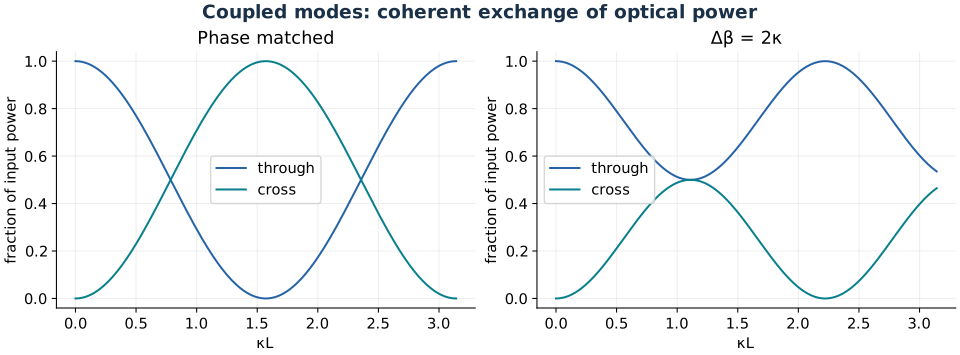
Phase matching permits complete exchange; mismatch limits it.
Problem 8.1 — Detuning for a zero-transfer output
Working. For the shortest complete-transfer coupler, \(\kappa L=\pi/2\). The first nonzero detuned zero occurs at \(gL=\pi\). Thus
Answer. The shortest-device result is \(\sqrt3\pi/L\). More generally, if the unperturbed device has \(\kappa L=(m+\frac12)\pi\), its first higher zero \(gL=(m+1)\pi\) requires \(|\Delta\beta|=(\pi/L)\sqrt{4m+3}\).
Check. The two conditions in the question must use compatible orders; setting the same symbols equal without squaring loses the order dependence.
Problem 8.2 — Required effective-index change
Working. Holding one guide fixed gives \(\Delta\beta=k_0\Delta N\). Divide the shortest-device answer of 8.1 by \(k_0\):
Answer. This is the required effective-index difference.
Check. A bulk material-index change equals this only for unit optical overlap. Otherwise include the perturbation overlap between the applied field and the guided mode.
Problem 8.3 — Numerical detuning for a centimetre coupler
Working. Use \(\lambda_0=0.9\,\mu{\rm m}\) and \(L=10^4\,\mu{\rm m}\):
Answer. Approximately \(7.79\times10^{-5}\).
Check. Index is dimensionless; using 1 for the length while leaving wavelength in micrometres would give an erroneous factor of 10,000.
Problem 8.4 — Which index gives stronger coupling?
Working. With otherwise identical guides and cladding, a larger core index normally strengthens confinement and shortens the evanescent tail. The coupling integral samples the other guide’s field in that tail.
Answer. Under this fixed-cladding, comparable-mode assumption, the lower-index pair B has greater tail overlap and generally larger \(\kappa\).
Check. Core index alone does not establish a universal theorem: cladding index, mode order, normalization, and geometry must be held consistent. Near a mode cutoff, compare the actual overlap integrals.
Problem 8.5 — Lossy three-decibel divider
Working. At phase match, equal surviving outputs require \(\kappa L=\pi/4\). With \(\kappa=4\,{\rm cm}^{-1}\),
Doubling length makes \(\kappa(2L)=\pi/2\).
Answer. The shortest divider is 1.9635 mm long. At double length the ideal through output is zero and the cross output is \(e^{-0.6(2L)}\simeq0.79008\) of input power.
Check. “3 dB divider” means equal splitting of surviving power; with propagation loss neither output receives exactly half the input.
Problem 8.6 — Nanometre-unit coupling length
Working. The supplied coupling coefficient already contains the geometric and material information. Therefore
Answer. Approximately 63.91 micrometres.
Check. The full-transfer length is twice this value. The other waveguide dimensions need not be inserted a second time.
Problem 8.7 — Why synchronous coupling can transfer all power
Working. Two identical isolated-guide modes combine into even and odd supermodes with propagation constants approximately \(\beta\pm\kappa\). Exciting one guide creates an equal superposition. Their relative phase grows as \(2\kappa z\). At \(2\kappa L=\pi\), destructive interference cancels one guide’s field and constructive interference reinforces the other.
Answer. With phase match, nonzero overlap, and negligible loss, complete transfer occurs at \(L=\pi/(2\kappa)\).
Check. Detuning reduces the maximum transferable fraction to \(\kappa^2/[\kappa^2+(\Delta\beta/2)^2]\). The effect is coherent mode beating, not photon absorption and re-emission.
Problem 8.8 — Control the coupling coefficient
Working. During fabrication, adjust gap, ridge width/height, etch depth, and material contrast. A smaller gap or more extended tails generally increase the overlap integral. After fabrication, electro-optic, thermo-optic, carrier, or mechanical perturbations can change mode confinement and therefore coupling.
Answer. Control the spatial overlap to change \(\kappa\). Use differential index tuning to introduce \(\Delta\beta\) when the goal is switching rather than changing overlap itself.
Check. Changing transfer by detuning is not automatically a change in \(\kappa\). The two quantities appear separately in (1).