Appendix A: Aperture Properties of Centered Systems
Source: Gerrard and Burch, Introduction to Matrix Methods in Optics (1975), Appendix A.
Illustrative problem
Problem A.1 — Stops, pupils, windows, and field in a finder telescope
Brief solution
1. Method.
The finder has a 30-mm-diameter, 100-mm-focal-length objective and a 5-mm-diameter, 10-mm-focal-length eye lens. The lenses are confocal, with a 6.5-mm diaphragm at their common focus. Choose reference planes on both sides of each lens and form cumulative transfer matrices back toward the objective.
2. Key step.
Its conjugate entrance window lies 1.1 m to the left of the objective and has diameter 50 mm. Intersecting the stop boundaries in the normalized \((\phi,\eta)\) aperture diagram gives
3. Answer.
The corresponding apparent angles in image space are ten times larger. Moving the eye 5 mm toward the eye lens (to 6 mm) introduces no additional limit because the eye lens still dominates. Moving it 5 mm away (to 16 mm) clips the opposite side and reduces the total field radius to \(0.0281\ \mathrm{rad}\), or \(\boxed{3.22^\circ}\) full diameter.
Show detailed steps
The finder has a 30-mm-diameter, 100-mm-focal-length objective and a 5-mm-diameter, 10-mm-focal-length eye lens. The lenses are confocal, with a 6.5-mm diaphragm at their common focus. Choose reference planes on both sides of each lens and form cumulative transfer matrices back toward the objective.
The overall matrix is afocal with angular magnification \(-10\). For each physical aperture of radius \(J_k\), compare \(J_k/|(L_{11})_k|\); the smallest value identifies the aperture stop. The objective rim wins, so
Imaging the objective through the eyepiece puts the exit pupil (Ramsden disc) 11 mm to the right of the eye lens, with diameter 3 mm. The observer’s 4-mm pupil therefore passes the axial bundle when centered there, although the lateral tolerance is only about \(\pm0.5\ \mathrm{mm}\).
For principal rays, compare the maximum field angle allowed by every stop. The 5-mm eye-lens rim, rather than the focal-plane diaphragm, limits the principal field:
Its conjugate entrance window lies 1.1 m to the left of the objective and has diameter 50 mm. Intersecting the stop boundaries in the normalized \((\phi,\eta)\) aperture diagram gives
Field definition |
Radius (radians) |
Diameter (degrees) |
|---|---|---|
Full illumination |
\(0.0091\) |
\(1.04^\circ\) |
Principal-ray field |
\(0.0227\) |
\(2.60^\circ\) |
Total field |
\(0.0325\) |
\(3.72^\circ\) |
The corresponding apparent angles in image space are ten times larger. Moving the eye 5 mm toward the eye lens (to 6 mm) introduces no additional limit because the eye lens still dominates. Moving it 5 mm away (to 16 mm) clips the opposite side and reduces the total field radius to \(0.0281\ \mathrm{rad}\), or \(\boxed{3.22^\circ}\) full diameter.
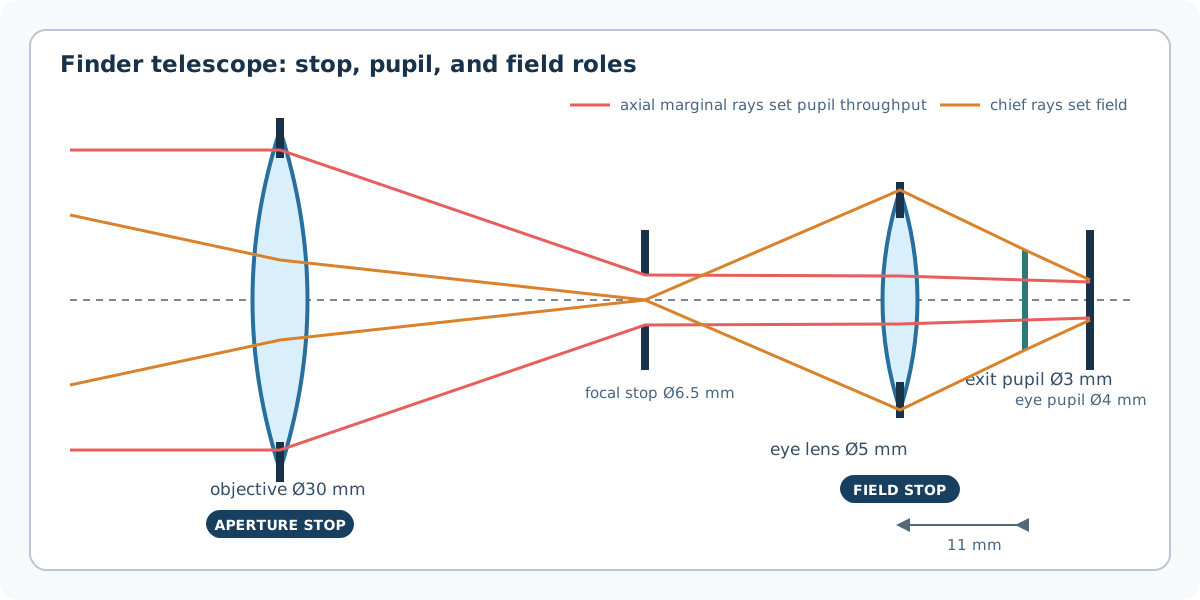
The matrix calculation distinguishes the stop itself from its entrance and exit pupil images; the field calculation uses chief-ray rather than marginal-ray limits.