Chapter 15: Distributed-Feedback Lasers
Source: Hunsperger, sixth edition (2009), Problems 15.1–15.8, printed pages 321–322.
Problem 15.1 — First-order GaAs feedback period
Working. Backward guided-wave feedback requires \(2\beta=2\pi/\Lambda\). At 0.895 micrometres the Table 4.2 GaAs index is approximately 3.57411. Approximating modal index by that material value,
Answer. Approximately 125.2 nm.
Check. The exact period uses the guided effective index and therefore depends on the vertical structure. A bulk index is the implicit approximation when no guide geometry is supplied.
Problem 15.2 — Feedback period in Al0.2Ga0.8As
Working. Table 4.2 at the same wavelength gives \(n(x=0.2)=3.43621\). Repeat the first-order condition:
Answer. Approximately 130.2 nm in the material-index approximation.
Check. Reducing index increases the required geometric period for a fixed vacuum Bragg wavelength.
Problem 15.3 — Two prism-assisted exposure geometries
Working. For writing wavelength 325 nm, the period from 15.1 requires \(n_p\sin\alpha=\lambda_w/(2\Lambda)=1.29786\). Two possible design pairs are
Answer. A UV-transparent fused-silica prism near index 1.48 and a quartz prism under the book’s 1.65 index assumption give these illustrative angle choices.
Check. Verify the actual writing-wavelength index and UV transmission of the selected material. Index must exceed 1.29786; an opaque high-index prism is not useful.
Problem 15.4 — Fourth-order feedback and scattering directions
Working. An order-4 backward condition satisfies \(4K=2\beta\), with \(K=2\pi/\Lambda\). Hence \(\Lambda=2\lambda_0/N\). The intermediate grating orders have axial components \(\beta_\ell=\beta-\ell K=\beta(1-\ell/2)\).
Answer. In the simple same-index wavevector construction, \(\cos\theta_\ell=1-\ell/2\) gives directions 0, 60, 90, 120, and 180 degrees for \(\ell=0,1,2,3,4\). The perpendicular order requires \(\ell=m/2\), an integer, so it is absent for odd backward-feedback orders.
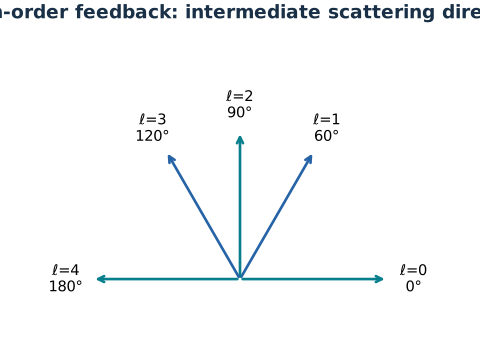
Same-index wavevector construction for the intermediate orders.
Check. Escaping radiation must additionally satisfy the cladding dispersion and refraction conditions. The wavevector construction does not guarantee equal power in all orders.
Problem 15.5 — Bragg wavelength and index tuning
Working. For first-order feedback,
At fixed period, \(\delta\lambda/\lambda=\delta N/N\). A one-part-in-ten-million index increase gives \(\delta\lambda=9.12\times10^{-5}\) nm and \(\delta\nu/\nu=-10^{-7}\).
Answer. Nominal wavelength 912 nm; frequency shifts downward by approximately 32.872 MHz for a positive index change of that fraction. A negative index change reverses both signs.
Check. Do not confuse a fractional change \(10^{-7}\) with an absolute index change of \(10^{-7}\).
Problem 15.6 — High-gain DFB frequency and spacing
Working. The Bragg angular frequency is \(\omega_B=2\pi c/(2N\Lambda)=2.24378\times10^{15}\,{\rm rad/s}\). The book’s high-gain approximation gives
Taking \(n_g\simeq N=3.65\) and \(L=300\,\mu{\rm m}\), \(\pi c/(n_gL)=8.60115\times10^{11}\,{\rm rad/s}\).
Answer. The \(m=0\) branch has \(\omega_0\simeq2.24335\times10^{15}\,{\rm rad/s}\). Adjacent orders on that branch are separated by \(8.60115\times10^{11}\,{\rm rad/s}\).
Check. The lowest-order oscillation is shifted from the Bragg frequency by half a spacing. A general DFB spectrum also depends on coupling and boundary conditions; the supplied high-gain assumption is what permits this simplified answer.
Problem 15.7 — Second-order gratings
Working. A second-order feedback grating has \(K=\beta\). Its first scattering order therefore has zero longitudinal wavevector and can couple light out perpendicular to the guide. That radiation drains power from an edge-emitting laser instead of contributing only to backward guided feedback.
Answer. Avoid that extra radiation loss in a conventional edge-emitting DFB; exploit it in a surface-emitting grating laser.
Check. Whether an order actually radiates depends on the surrounding optical structure, but second-order designs make the normal-outcoupling momentum available.
Problem 15.8 — Interpret the frequency-spacing units
Working. Converting the angular-frequency spacing to hertz,
Answer. Approximately 165.63 GHz, or \(1.65631\times10^{14}\) mHz if the printed lowercase unit is taken literally. It is 165631 MHz if MHz was intended.
Check. Lowercase m means milli, uppercase M means mega. The physical spacing of this short cavity is not millihertz.